
December 9, 2025
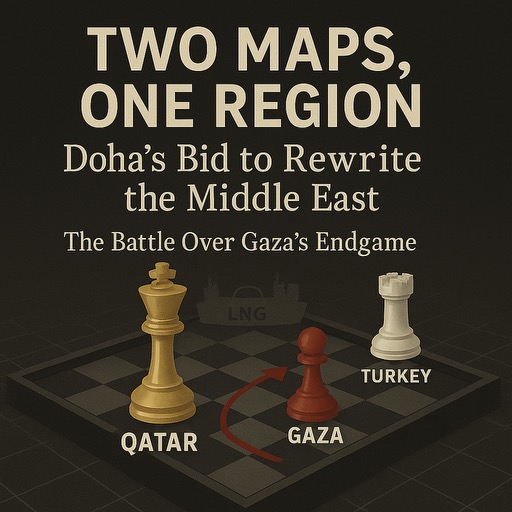
The Doha Forum 2025 exposed a fundamental divide emerging in the Middle East. It revealed two competing frameworks for what comes after Gaza: one developed in Washington and reinforced by Israel, and another being built quietly through Qatar and Turkey. These two maps are moving toward different outcomes and are shaped by different timelines. They will not remain parallel for long.
Washington’s new National Security Strategy makes clear that the Middle East is no longer the center of U.S. foreign policy. Israel is positioned as a regional stabilizer, and the Abraham Accords form the backbone of the next phase of cooperation. In this design, Gaza cannot return to a structure governed by Hamas. A new political and security arrangement must take shape that aligns with state actors, not militias.
Doha presented its own alternative by gathering the actors who prefer a different path: a slower transition, international oversight, and a phased approach that preserves political space for Hamas while weakening Israel’s operational autonomy.
Qatar’s Repositioning: Influence Without Responsibility
Qatar’s prime minister, Sheikh Mohammed bin Abdulrahman Al Thani, used his appearance at the Forum to declare that Qatar would not fund Gaza’s reconstruction. This marks a significant departure from years of financial support to Gaza, often under arrangements coordinated with Israel and the United States.
By stepping back publicly, Doha redefines its position. It seeks to remain central to negotiations while distancing itself from the financial and political burdens of postwar Gaza. Qatar is not withdrawing from Gaza’s future; it is repositioning itself to shape it without absorbing its costs.
Turkey’s Sequencing Strategy: A Framework Built to Delay Final Outcomes
Turkey arrived with a strategic message. Foreign Minister Hakan Fidan argued that disarming Hamas should not be the first step of any Gaza plan. Instead, he proposed a sequence involving a civil administration, a Palestinian police force, an international stabilization mission, and disarmament at the end. Recent Turkish statements indicating readiness to send troops to Gaza under an International Stabilization Force highlight how Ankara envisions a role that extends beyond diplomacy.
This sequence is political, not procedural. It delays Hamas’s dismantling long enough for political conditions to shift — in Israel, in the United States, and across the region. It reflects Ankara’s effort to preserve leverage and avoid the rapid collapse of Hamas’s political relevance.
Qatar shares these incentives. Both capitals prefer a U.S. posture that pressures Israel rather than reinforces it. They prefer a transition long enough to reshape the environment around them.
The extended timeline that Qatar and Turkey promote is not administrative. It is strategic. Both governments prefer conditions in which Washington leans toward gradualism, international bodies play central roles, and Hamas has time to adapt. A transition into late 2026 allows space for U.S. political dynamics to shift, for Israeli coalition instability to intensify, and for negotiations to influence Gaza before facts on the ground do. The timeline is part of the plan.
Rebranding the Past: Doha’s Willingness to Redefine Legitimacy
Doha also presented Syria’s “new president,” Ahmad al-Sharaa — formerly Abu Mohammed al-Julani, the ex-leader of an Al-Qaeda affiliate. His participation signaled Doha’s readiness to normalize figures excluded from most international forums.
Western Influence: Qatar’s Long-Term Investment in U.S. Narratives
The Forum featured American figures such as Tucker Carlson and Donald Trump Jr., reflecting Qatar’s strategy of cultivating influence across U.S. political lines ahead of 2026.
Regional Memory and Unresolved Distrust
Saudi Arabia and Egypt retain deep concerns about Qatar’s past alliances. Their skepticism remains, even as Doha reframes its role.
Two Incompatible Maps Converging on 2026
The Washington–Israel map calls for Hamas’s removal, early stabilization, and demilitarization. The Doha–Ankara map delays these outcomes through phased processes, international oversight, and extended timelines.
These strategies are incompatible. One favors resolution; the other favors delay.
“2026 will decide which map becomes the foundation for the next Middle East.”
2026: The Year the Two Maps Meet
Several processes converge in 2026: Israeli political pressures, U.S. electoral dynamics, reconstruction decisions, and regional security mandates. Doha’s approach relies on delay. Washington and Jerusalem’s approach relies on resolution.
A Clear Divide Emerging
The Doha Forum exposed alignment, not ambiguity. Qatar and Turkey are advancing a Gaza outcome fundamentally different from the U.S.–Israel vision. They are shaping an alternative path based on time, diplomacy, and political shifts.
The region now has two strategic maps. 2026 will determine which one becomes the foundation of the next Middle East.
Author’s Note
This analysis is based on publicly available statements, regional diplomatic patterns, and the structural shifts revealed during the Doha Forum 2025. Understanding these parallel maps is essential for interpreting the decisions that will unfold in 2026.