January 12, 2025
There are moments in history when systems that appear fundamentally different in language, culture, and declared belief begin to reveal a shared internal logic, not because they consciously imitate one another, but because they are constructed on the same assumption about authority and truth, and it is in those moments that comparison becomes necessary rather than provocative, because history does not move according to labels but according to structure, and structure, once visible, is difficult to ignore.
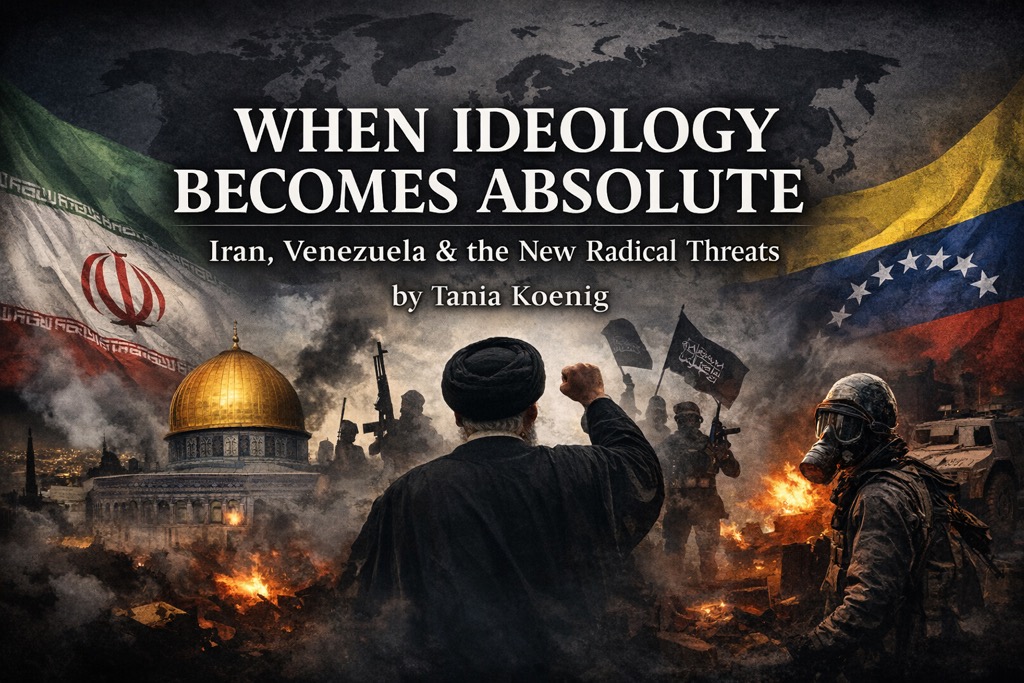
Iran, Venezuela, and the radical political movements now emerging within Western societies are often treated as unrelated phenomena, separated by religion, geography, and ideology, yet this separation dissolves once analysis shifts away from doctrine and toward the way power is justified and exercised, because what ultimately determines the trajectory of a system is not whether it speaks in the language of God, class, justice, or revolution, but whether it claims moral absoluteness and therefore places itself beyond limitation, accountability, and pluralism, a posture that history shows is both seductive and fatal.
Islamic fundamentalism and communism are not the same belief systems, nor do they arise from the same historical sources, yet politically they converge at a critical point where authority ceases to be provisional and becomes absolute, where legitimacy is not earned through performance or consent but asserted through moral inevitability, whether framed as divine command or historical destiny, and once a system crosses that threshold dissent no longer functions as a political position but as a moral offense, disagreement becomes betrayal, and institutions cease to restrain power and instead exist to enforce virtue as defined by those who rule.
When that shift occurs, repression is no longer an excess or a failure of the system but a requirement for its survival, because a system that claims moral perfection cannot tolerate contradiction without undermining its own foundation, and it is precisely at this stage that ideology begins to hollow out, not because it is defeated intellectually, but because it is no longer experienced as credible by those who live under it, even as it continues to operate administratively and coercively, sustained by fear rather than belief.
Iran today occupies this historical interval, no longer sustained by widespread conviction in clerical legitimacy yet still fully operational as a governing apparatus, ruled less by theology than by security management, economic containment, and institutional inertia, a condition that becomes visible not through official proclamations but through the increasing reliance on force rather than persuasion, on surveillance rather than trust, and on nationalism rather than religious authority as the language of cohesion, signaling not collapse but exhaustion, not the end of the system but the end of its capacity to renew itself.
This is where the comparison with the late Soviet Union becomes structurally valid rather than rhetorically convenient, because by the mid-1980s the Soviet system was no longer animated by Marxist belief yet remained intact as a governing machine, sustained by bureaucratic momentum, security enforcement, and the absence of viable alternatives, allowing it to persist for years after its ideological core had emptied, which is why the fall of the Berlin Wall did not initiate collapse but revealed that fear no longer functioned as a universal constraint, while the formal dissolution of the Soviet Union occurred later through administrative unraveling once elite cohesion fractured and authority lost coherence.
Iran has not reached that moment, and there is no serious analytical basis for expecting it to do so in 2026, because systems do not fall when they are rejected by the population but when the mechanisms that enforce obedience fail to reproduce themselves, a process that historically centers on succession, elite fragmentation, or visible loss of control rather than protest alone, which explains why regimes can endure widespread dissatisfaction without collapsing, just as the Soviet Union did for more than a decade after belief had quietly withdrawn.
Venezuela provides a crucial parallel because the Chávez–Bolivarian system is a formally secular, ideologically atheistic structure that derives its authority from revolutionary morality and state power rather than from theology, which allows the underlying mechanism of centralized coercion and moral absolutism to be seen in isolation, whereas in Iran the same structure is fused with a clerical theocracy rooted in a fundamentalist revolutionary interpretation of Shi’a Islam, an interpretation that is political, absolutist, and expansionist in nature, that claims divine legitimacy for state power, fuses religious authority with coercive government, and explicitly includes as part of its ideological mandate the destruction of Israel and the seizure of Jerusalem, thereby confirming that the conflict described here is not against flesh and blood but against powers, authorities, and governing structures, precisely as described in Ephesians 6.
Scripture itself provides a precise historical parallel to this structural reality in the account of Esther, where an entire people was placed under a legally enacted death sentence, not through chaos but through an authorized decree issued by imperial power, and where deliverance did not come through protest, violence, or emotional appeal, but through fasting, lawful approach, and juridical exposure of illegitimacy, as Esther understood that a decree could only be overturned by a higher authority operating within proper order, which is why she fasted, entered the king’s presence according to protocol, appealed to covenantal identity, and forced the decree into the open, resulting not in disorder but in lawful reversal, demonstrating that systems governed by absolutist power are not defeated by outrage but by the removal of legal standing, a pattern that remains unchanged across history.
If the Church is to participate meaningfully in this moment, it must recover the biblical understanding that prayer is not an emotional reaction to events, but a juridical act exercised within delegated authority, because Scripture consistently presents intercession as legal engagement rather than supplication detached from responsibility.
This is why Moses, when confronted with the Lord’s declaration that Israel would be destroyed after the golden calf, entered into juridical argument grounded in covenant and promise (Exodus 32:9–14), and Daniel enforced fulfillment through fasting and prayer when he discerned the appointed time (Daniel 9:2–5; 10:12–13), and Esther overturned a death decree through lawful appeal and fasting (Esther 4:15–16; 7:3–6; 8:8).
Yeshua Himself confirmed this legal framework by granting authority to bind and to loose (Matthew 16:19; 18:18), and the apostles defined spiritual conflict as engagement with rulers, authorities, and powers rather than flesh and blood (Ephesians 6:12–18).
Romans 4:17 must therefore be read juridically, because calling into existence what does not yet exist is authoritative speech grounded in divine verdict.
When the Church prays in this manner, it does not invent outcomes, but removes resistance, withdraws consent from illegitimate authority, and shortens the distance between decision and manifestation, until history complies.
This is how the Church responds.