
February 3, 2026
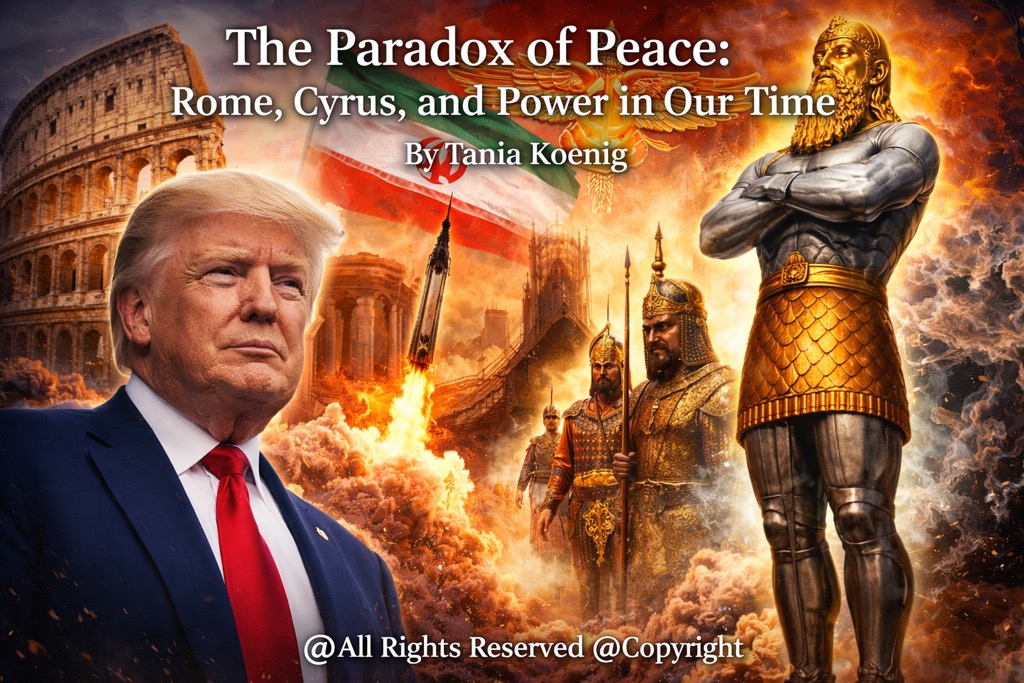
President Trump’s way of exercising power has been widely misunderstood because it does not fit the assumptions of modern diplomacy. He does not operate primarily through process, consensus, institutions, or rules-based order. He operates through authority, pressure, timing, and sequence. To understand what is unfolding now with Israel, Gaza, and Iran, one must step outside twentieth-century diplomatic frameworks and return to older patterns of power—patterns history records plainly and Scripture itself recognizes.
Trump enforces order in a Roman way, while at times enabling Cyrus-like restoration outcomes. But he never reverses the sequence. Power comes first. Peace follows. This sequence explains why the same actions that alarm diplomats often restrain adversaries, and why what appears chaotic to some is in fact structured.
Rome After Augustus: Authority Before Peace
Trump aligns most closely with Imperial Rome after Augustus, not with the Senate-era Republic and not with modern liberal governance.
Rome learned through collapse and civil war that endless debate does not restrain violence. Authority does. Augustus centralized power, restored hierarchy, imposed order, and only then did Rome experience peace. The Pax Romana was not sentimental, negotiated, or idealistic. It was enforced.
This Roman peace—Pax Romana—was achieved not by the absence of war but by the presence of overwhelming authority, where force was openly acknowledged as the instrument through which peace was secured.
Peace, for Rome, was never the absence of war. It was the result of undisputed authority.
Trump governs with the same instinct. He bypasses bureaucratic paralysis and uses executive authority to impose clarity. When he speaks loudly, moves forces visibly, or imposes sanctions and tariffs, critics see recklessness. Rome would have seen deterrence.
Rome displayed its legions to prevent rebellion. Trump displays pressure—carrier groups, sanctions, tariffs, and public warnings—for the same reason. Visibility is not escalation. It is deterrence. When power is unmistakable, enemies calculate more carefully.
This is why Trump consistently leaves an off-ramp. Rome allowed submission before destruction. Trump does the same. Iran can talk. Hamas can disarm. War remains credible, but not inevitable.
Rome punished selectively and publicly when necessary. Trump avoids endless wars but accepts decisive moments. He prefers short, sharp actions to prolonged entanglements. Peace is preserved by example, not exhaustion.
Rome never pretended war did not exist. It institutionalized it. War and peace were instruments within the same system. Peace flowed from war properly ordered. That is why the language of Secretary of War matters. It reflects an older truth: peace is not achieved by denying force, but by commanding it.
Persia, Cyrus, and Pressure From Within
If Rome explains Trump’s method of authority, Persia explains his method of pressure, particularly toward Iran.
The Achaemenid Persian Empire did not rely primarily on conquest. It ruled through patience, psychological dominance, and internal fracture. Persia preferred compliance to annihilation.
Trump’s approach to Iran mirrors this logic.
Persia understood time as leverage. Trump uses pressure—economic, diplomatic, informational—to weaken regimes from within. Iran fears this more than bombs because internal collapse cannot be controlled.
Recent reporting confirms that Iran considers its defensive capabilities non-negotiable and remains on maximum readiness, while treating negotiations as a test of whether U.S. pressure is real. This posture does not signal confidence; it signals strain.
Persia ruled minds before cities. Trump’s unpredictability destabilizes opponents. They cannot game a system they cannot read. That uncertainty itself becomes pressure.
Persia preferred internal fracture to invasion. Trump pressures regimes until cracks appear. This is why Iran fears him—not because of immediate destruction, but because regime fragility becomes visible under sustained pressure.
Trump acknowledged this openly on January 13, urging Iranian patriots to keep protesting, to document abuses, and warning that those responsible would pay a heavy price. He canceled meetings with Iranian officials and imposed tariffs on anyone doing business with Iran. This was not rhetoric. It was pressure aimed inward.
Cyrus belongs here—but only in sequence. Cyrus was not a believer; yet God called him “My anointed.” He was used as an instrument to enable restoration. Trump does not rule like Cyrus. He rules like Rome. But at times his actions enable Cyrus-like outcomes by removing blockages and reordering conditions. That is not contradiction. It is sequence.
Pressure Becomes Visible: Escalation in Real Time
In the past hours, events have moved from theory to practice.
An Iranian unmanned aerial vehicle loitered near the USS Abraham Lincoln after being warned to stay clear. It was subsequently shot down by a U.S. Air Force F-35 as it approached the carrier strike group. At the same time, Iranian gunboats surrounded the U.S.-flagged tanker M/V Stena Imperative, part of the U.S. Navy’s Tanker Security Program, while the vessel remained in international waters.
According to i24 News, an Iranian Mohajer drone also flew toward the Stena Imperative in parallel with the gunboat activity, adding an aerial component to the maritime provocation. This coordination is not accidental. It reflects deliberate boundary testing without crossing into declared war.
At the diplomatic level, Reuters reports that Iran is seeking to relocate Friday’s talks from Istanbul to Oman, to limit discussions strictly to the nuclear issue, and to conduct negotiations exclusively with the United States, excluding other Arab and Muslim states. This move narrows the frame and reduces external pressure at the very moment military tension is rising.
Inside Iran, hardline political figures have publicly called for ending negotiations and even for pre-emptive strikes against Israel and U.S. bases in the region. This is not confidence. It is internal pressure surfacing.
These events are not random. They form a coherent pressure sequence.
Iran is testing boundaries simultaneously across domains—maritime, aerial, and diplomatic. The United States is responding with restraint backed by force. Drones are shot down. Shipping lanes are defended. Negotiations remain conditional. War remains possible, but controlled.
This is not de-escalation. It is managed escalation—pressure applied deliberately to shape outcomes before decisions harden into war.
Developments Confirming the Sequence
According to the Prime Minister’s Office,
The meeting between Prime Minister Benjamin Netanyahu and U.S. President’s Special Envoy Steve Witkoff has concluded.
The Prime Minister emphasized the uncompromising demand for the disarmament of Hamas, the demilitarization of the Gaza Strip, and the completion of the war’s objectives before the reconstruction of Gaza.
The Prime Minister made clear that the Palestinian Authority will not take part in administering the Gaza Strip in any way and informed U.S. Ambassador Hochstein of the serious violations discovered in Gaza involving the use of UNRWA bags to conceal weapons.
Ahead of Envoy Witkoff’s trip to meet an Iranian representative, the Prime Minister reiterated his position that Iran has repeatedly proven it cannot be trusted to keep its promises.
Iran wants to change the venue of Friday's talks with the U.S. from Turkey to Oman, a regional diplomat told Reuters. The diplomat said that Tehran is also seeking to change the scope of the talks to focus only on the nuclear file, and does not want the direct participation of regional countries, despite claiming earlier that their participation was Tehran's initiative.
A military source to Channel 14 News about the meeting with Witkoff stated:
“We warned the Americans that the Iranians will violate any agreement and that there is no point in trying to reach one. Under an agreement, they will not dismantle their nuclear and missile capabilities, and part of the reasons they are trying to buy time is apparently to transfer offensive weapons to hiding places.”
The White House announced that despite recent reports, the talks with Iran scheduled for later this week are expected to proceed as planned: “Trump wants diplomacy”
Venezuela, Greenland, and the Same Pattern
What is unfolding around Iran is not unique. It follows a pressure architecture President Trump has already used elsewhere, without invasion and without overt regime change, but through layered dominance that shifts authority while leaving structures formally intact.
In Venezuela, there were no U.S. troops and no invasion. Instead, Trump applied layered pressure—sanctions, financial isolation, shipping pressure, airspace constraints, and diplomatic leverage. The regime remained, but authority shifted. Compliance followed without regime change.
Greenland follows the same logic. Trump does not speak of conquest. He speaks of inevitability, leverage, and responsibility. Pressure first. Control next. Arrangements later.
These are not isolated cases. They reveal a governing pattern.
Iron Mixed With Clay: The Internal Condition of America
Daniel’s statue is not only a timeline. It is a diagnosis.
The final phase is iron mixed with clay—strength outward, fragility inward.
The clay is not external. The clay is inside America.
It is internal fracture accompanying global power: political polarization so severe that elections become existential battles; riots in the streets; institutions turned against one another; cultural warfare; economic strain; and a national debt now exceeding $38.5 trillion. This internal brittleness does not cancel American power, but it limits its endurance.
Iron can dominate, deter, sanction, strike, and reorganize the map. Clay cannot bind. Clay fractures under stress and resists cohesion.
Trump governs like iron in a clay society. Iron can act. Clay struggles to hold. Enemies understand this. Iran waits, hoping internal fracture interrupts external pressure.
Iron can begin the operation. Clay can interrupt it.
That is the danger Daniel identified.
The Stone Cut Without Hands
Daniel’s vision does not end with iron managing the world indefinitely. He sees a stone cut without hands strike the statue at its feet. The entire system collapses, not because one empire defeats another, but because human power reaches its limit.
Trump is not building that kingdom. He is operating within the logic of the iron empire—restoring order, enforcing hierarchy, and enabling outcomes through power. Scripture shows that God often uses empires as instruments, even when they do not recognize Him.
Final Conclusion
Trump is not improvising. He is reviving an older form of statecraft that modern systems forgot how to read.
That is why critics call him chaotic. That is why allies feel uneasy. That is why adversaries hesitate.
Empires never survived by being liked. They survived by being understood and feared.
And history, once again, is moving according to patterns that were revealed long ago—until the day the stone falls, and the kingdoms of this world become the Kingdom of our Lord and of His Christ.