
February 9
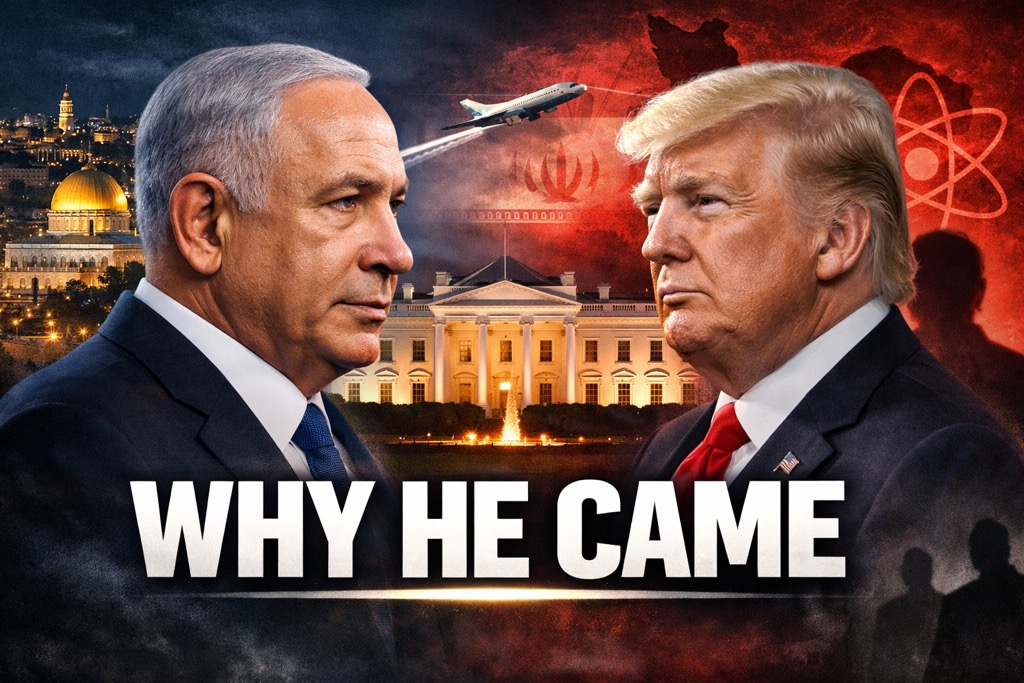
Prime Minister Benjamin Netanyahu abruptly moved up his scheduled visit to Washington this week to meet with U.S. President Donald Trump, not for a routine call, but to deliver an in-person intelligence briefing on Iran’s escalating threat. The visit follows a recent assessment Netanyahu shared with U.S. special envoy Steve Witkoff during his visit to Israel, underscoring the importance Netanyahu places on how this information is conveyed.
Israeli and U.S. officials say the meeting will focus on Iran’s nuclear and ballistic missile programs, its support for regional proxy forces, and the violent suppression of internal protests — all central elements of the Islamic Republic’s power structure. Israel is determined that Washington’s approach align with its core security priorities, not merely with narrow diplomatic progress.
Why Netanyahu Decided to Come Himself
According to Israeli media citing sources close to the prime minister, Netanyahu chose to shorten the interval before his Washington meeting so President Trump would receive directly the same detailed briefing previously shared with Witkoff, ensuring no nuance or urgency was lost.
Israeli officials have stressed that accurate intelligence and unified threat perception are critical, particularly given the complexity of Iran’s programs and indications that negotiated agreements could exclude elements Israel considers non-negotiable, including ballistic missiles and proxy warfare.
It is also notable that Netanyahu chose to deliver this briefing personally rather than allowing the envoy Steve Witkoff to carry the full weight of Israel’s assessment. In diplomatic language, this can be framed as a courtesy. In strategic reality, it reflects something deeper. When the threat is existential, Israel does not want its warning translated into deal terms or softened into process. Netanyahu chose direct delivery — prime minister to president — because this is not a negotiation problem. It is a survival problem.
The Broader Diplomatic Battlefield
Netanyahu’s visit coincides with a flurry of diplomatic activity involving U.S. envoys, Iran, and Gulf states. The United States has been conducting indirect talks with Iran in Oman aimed at limiting Tehran’s nuclear enrichment, but those discussions have faced significant hurdles. Iranian officials have signaled openness to what they call “fair” talks on nuclear issues, while insisting that key elements remain non-negotiable. Internal unrest in Iran continues to shape the regime’s calculations.
Meanwhile, Israeli and U.S. negotiators remain at odds over the scope of any potential agreement. Israeli demands include not only dismantling Iran’s nuclear weapons program, but also placing limits on ballistic missiles and ending support for militant proxy groups such as Hezbollah — provisions Iran has resisted and may continue to oppose.
Why This Matters Strategically
The coordination between Jerusalem and Washington highlights a critical moment in U.S.–Israeli relations and Middle East security. Netanyahu’s decision to brief the U.S. president personally reflects both the gravity Israel assigns to Iran’s capabilities and the importance it places on ensuring that its assessment is received without dilution at the highest level.
For Israel, Iran’s pursuit of nuclear capacity and long-range missiles is not theoretical. It is an existential threat — one that has already reshaped regional dynamics, influenced defensive actions, and drawn U.S. military assets deeper into the region.
President Trump’s administration has stated that any negotiation with Iran must go beyond nuclear limits and include ballistic missile programs and regional proxy warfare — positions that align closely with Israeli red lines.
When Intelligence Precedes Action
It is also worth noting that this is not the first time a high-level meeting between Prime Minister Netanyahu and President Trump has been followed by consequential action beyond Israel itself. During Trump’s current term, similar exchanges of intelligence and strategic planning were followed by decisive U.S. action on other fronts, including the unprecedented operation in Venezuela that resulted in the capture of Nicolás Maduro and his wife. While each situation is distinct and causation should not be overstated, the pattern is clear: when intelligence and strategic planning are exchanged at this level, outcomes often extend beyond the immediate issue at hand. That history adds further weight to the significance of this visit.
Bottom Line
Netanyahu’s decision to accelerate his Washington visit and personally deliver intelligence reflects the high stakes surrounding Iran, the complexity of ongoing U.S.–Iran negotiations, and the depth of shared concern between Jerusalem and Washington. Whether this meeting produces unified red lines, clearer policy coordination, or sharper disagreements, it has implications that extend well beyond this week.
A Moment That Requires Discernment — and Prayer
This visit is not merely diplomatic. It is taking place at a moment when geopolitical danger and spiritual confusion are converging.
Iran’s nuclear ambitions, missile capabilities, and proxy warfare represent a clear and present threat. At the same time, the resurgence of antisemitism — especially when cloaked in moral or theological language — signals a deeper disorder that Scripture has long warned about.
For these reasons, this is a moment that warrants prayer.
Prayer for wisdom and clarity for those making decisions at the highest levels. Prayer that truth would not be filtered or softened. Prayer that Israel’s warnings would be heard with seriousness and sobriety. And prayer that discernment would prevail where confusion is pressing in.
This is not a time for panic or rhetoric. It is a time to see clearly, speak carefully, and pray earnestly.