
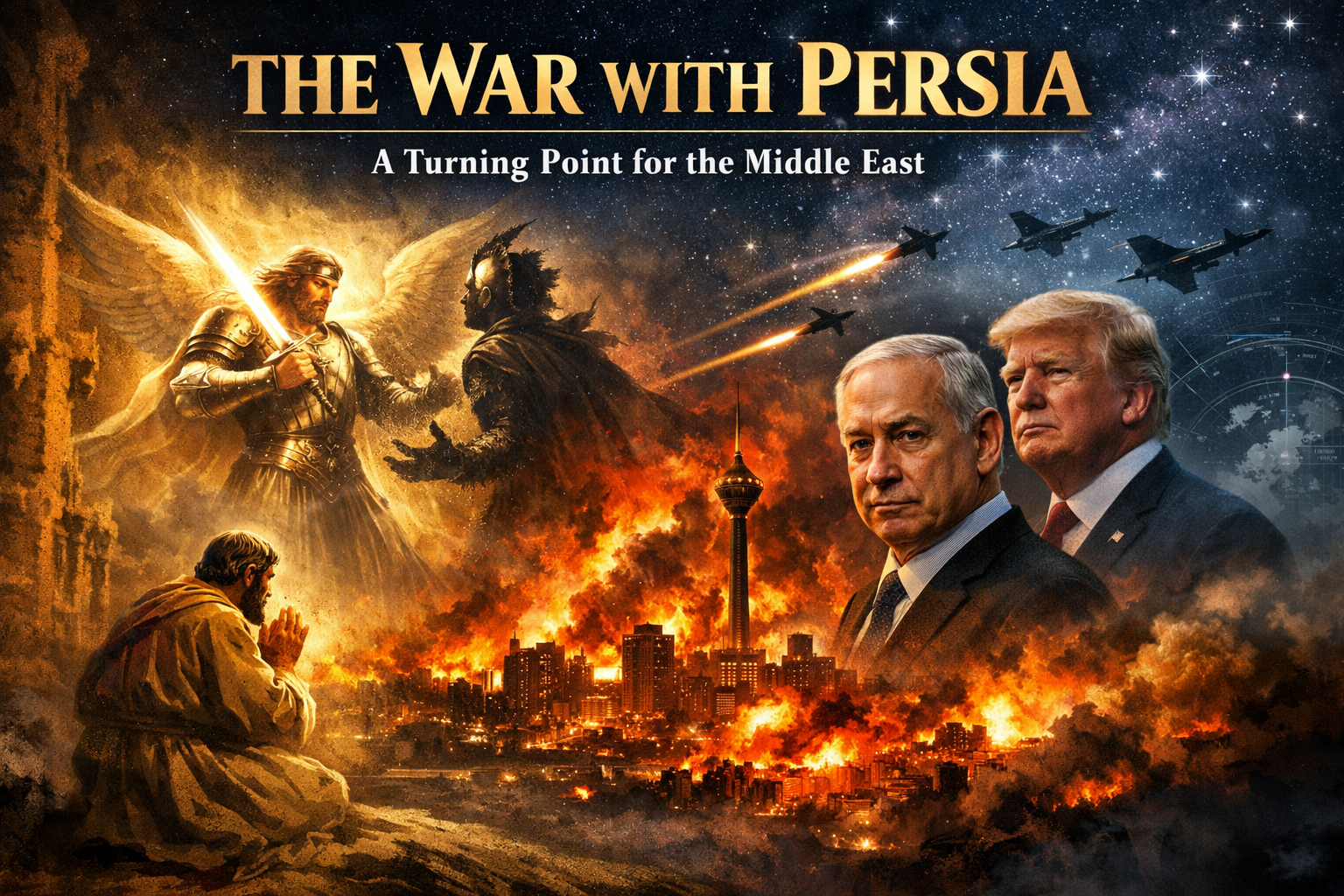
Military pressure, economic risk, and the language of Daniel reveal a deeper struggle behind the conflict.
“The prince of the kingdom of Persia withstood me… but Michael, one of the chief princes, came to help me.” — Daniel 10:13
A PERSONAL REFLECTION
Last night, around three o’clock in the morning, I woke with a heavy burden in my heart. I found myself crying out to the God of Israel — the God of Abraham, Isaac, and Jacob — asking Him to remember His promises to His people and to send His angels to protect Israel in this war.
I walked quietly through the house and stepped outside. The night was still. Looking up at the sky, I thought about Abraham when the Lord told him to lift his eyes toward heaven and count the stars if he could. Standing there beneath that same sky above the Middle East, it became clear to me that something far larger than the daily news cycle is unfolding in our time.
People speak constantly today about prophecy and the end times. There is certainly a place for those discussions. Yet what pressed on my heart in that moment was something simpler and deeper.
Israel must never rely only on the strength of nations.
America can help. Alliances matter. Strategy matters. But ultimately Israel must rely on the Lion of Judah — the God of Israel Himself.
He is the One who turned Gideon’s three hundred men into a force capable of defeating armies. He is the One who can send help from heaven when human strength is not enough.
And so my prayer that night was not only for Israel. It was also for the Church — that believers would awaken, seek God again, and long for the coming of the Bridegroom, Yeshua the Messiah.
THE WAR IS MOVING INTO A DIFFERENT STAGE
Over the past week the conflict between Iran, Israel, and the United States has changed in character.
In the opening days the picture seemed relatively straightforward. Missile bases were struck, military facilities targeted, and efforts were made to reduce Iran’s ability to fire rockets and drones across the region.
But wars rarely remain simple.
What we are witnessing now is something broader and more complex. The conflict is touching several layers at once: military pressure on Iran’s infrastructure, political pressure inside the Iranian system, shifting alliances across the region, and growing economic consequences that extend far beyond the battlefield itself.
These are the moments in history when events begin to accelerate and the deeper structure of power begins to change.
What is unfolding in these days is not simply another regional conflict; it is the exposure of a system of power that has shaped the Middle East for decades and whose consequences reach far beyond the battlefield.
NETANYAHU’S MESSAGE
Prime Minister Benjamin Netanyahu captured that sense of transformation in his recent press conference.
“We have achieved major accomplishments that will change the balance in the Middle East,” he said.
Those words reflect something deeper than a battlefield report — the possibility that the system Iran built over decades to pressure Israel is now being challenged in ways it has not faced before.
“The Iranian regime has built a system to annihilate Israel through its proxies, ballistic missiles, and nuclear project,” Netanyahu said.
From Israel’s perspective, the purpose of the current campaign is not simply retaliation but the dismantling of that entire system before it becomes irreversible.
Netanyahu also emphasized the historic depth of coordination with the United States, noting that he speaks regularly with President Trump and that the alliance between the two nations has reached an unprecedented level of strategic cooperation.
THE SYSTEM IRAN BUILT
For more than four decades Iran has pursued a strategy that relies less on direct confrontation and more on strategic positioning.
Rather than confronting Israel openly through conventional military power, Tehran gradually constructed a network capable of projecting influence across the region — Hezbollah in Lebanon, militias in Syria and Iraq, missile programs able to reach across borders, drone systems designed to evade air defenses, and pressure on maritime routes and energy infrastructure.
Through this network Iran extended its influence far beyond its borders while often remaining one step removed from direct confrontation.
But systems like this contain a hidden weakness.
Once they are exposed and placed under sustained pressure from multiple directions, they can begin to weaken far more quickly than they were built.
THE POWER BEHIND THE PROXIES
For many years the world focused on individual groups — Hamas in Gaza, Hezbollah in Lebanon, militias in Iraq and Syria. Yet those organizations did not emerge in isolation.
Since the Iranian Revolution in 1979, the regime in Tehran invested enormous resources in building a network of armed movements across the Middle East. Through funding, weapons, training, and ideological influence, Iran supported groups capable of confronting Israel and challenge U.S. influence throughout the region.
Over time this network developed into one of the most powerful strategic systems in the Middle East.
That is why the present conflict carries such weight. It is not simply a war against a single organization like Hamas, for which believers around the world prayed for two years during the hostage crisis.
What we are witnessing now reaches much deeper.
It is a confrontation with a structure of power that has been developing for more than four decades.
THE NUCLEAR QUESTION
Another layer of the conflict lies beneath the visible battlefield.
Satellite imagery suggests that while numerous Iranian military targets have been struck across the country, certain nuclear facilities — particularly the complex at Isfahan — have not been attacked in the same way.
That raises an important strategic question.
Iran’s enriched uranium stockpile is believed to be concentrated in a small number of facilities. Destroying those facilities through air strikes alone might bury the material underground without eliminating it permanently.
Reports circulating among analysts suggest that some of this material may have been moved to extremely hardened underground locations sometimes referred to as “Pickaxe Mountain,” a facility believed to be carved deep into granite.
If that is the case, the challenge becomes far more complex.
Destroying infrastructure is one thing. Securing nuclear material is another matter entirely.
THE ECONOMIC PRESSURE BUILDING
While the military campaign continues, another pressure is quietly forming beneath the surface.
The Persian Gulf is not only a strategic military region. It is also one of the most important energy corridors in the world. Nearly twenty percent of global oil supply passes through the Strait of Hormuz.
If instability spreads there, the consequences move rapidly through the global system. Oil prices rise. Transportation costs increase. Manufacturing becomes more expensive. Inflation pressures spread through economies far from the Middle East.
This is why wars in this region rarely remain local conflicts. They almost always ripple outward into the global economic system.
TRUMP’S WARNING ABOUT THE ECONOMY
President Donald Trump recently signaled concern about the economic dimension of the conflict in a message posted on Truth Social.
“Where is the Federal Reserve Chairman, Jerome ‘Too Late’ Powell, today? He should be dropping interest rates immediately, not waiting for the next meeting.”
Trump has long criticized the Federal Reserve for reacting too slowly to economic developments. But the timing of this message is notable.
In the midst of a geopolitical conflict that could affect oil markets, shipping routes, and global trade, the comment reflects concern that financial pressure could build quickly if economic policy fails to respond.
The war is therefore touching not only the battlefield but the global economic system as well.
A REGION IN TRANSITION
Perhaps the most striking development is the quiet shift taking place across the Middle East.
For years Israel faced missile threats largely on its own. Today several countries in the region are experiencing the same dangers directly: missiles crossing borders, threats to shipping routes, and pressure on energy infrastructure.
These are no longer distant risks. They are realities.
And when nations begin to experience the same pressures, alliances often begin to change. The Middle East may be entering a new strategic alignment.
THE LANGUAGE OF DANIEL
For that reason I see the present moment as more than a geopolitical struggle.
In Daniel 10:13 the angel speaking to Daniel explains that he was delayed because of a confrontation with what the text calls the “prince of the kingdom of Persia.”
The Hebrew word used there is sar (שַׂר), meaning a prince or ruler.
Later the angel says again in Daniel 10:20, “Now I will return to fight with the prince of Persia.”
Yet when the prophecy continues, the text also speaks about the “kings of Persia.” In Daniel 11:2 the Hebrew word used is melakhim (מְלָכִים), referring to literal human kings.
Scripture therefore describes both visible rulers and a deeper struggle connected with nations.
A CALL TO PRAYER
Scripture reminds us that the struggles we see are not always the only battles being fought.
“For we do not wrestle against flesh and blood, but against principalities, against powers, against the rulers of the darkness of this age, against spiritual forces of evil in the heavenly places.” — Ephesians 6:12
For moments like this, prayer led by the Holy Spirit becomes something far greater than a human response to events. It becomes participation in the unfolding of God’s purposes and in the fulfillment of the prophecies written long ago.
A MOMENT THAT WILL BE REMEMBERED
The events we are witnessing are not only military developments. They represent a moment where political power, economic pressure, and spiritual realities intersect.
For nearly half a century the system that emerged from the Iranian revolution of 1979 has shaped the strategic landscape of the Middle East. Today that system is being tested in ways that few imagined even a short time ago.
For believers, the response is clear. We seek wisdom, remain watchful, and pray that the God of Israel will guide the outcome of events larger than any nation or leader.
And tonight, as Abraham once lifted his eyes and counted the stars, we look at the same heavens above the Middle East knowing that the God of Abraham, Isaac, and Jacob still rules over the nations and continues to move history toward the fulfillment of His Word, bringing His prophetic purposes to pass, just as He did in the days of Daniel when the struggle over Persia was already unfolding before His throne.