
March 16, 2026
After the President’s speech this morning, one question dominated financial discussions across the world: why did global markets remain relatively stable despite a major war involving Iran, Israel, and the United States?
The answer lies in how financial markets actually operate. Markets price probability, not headlines. Investors do not react simply to the existence of war. They react to the likelihood of worst-case outcomes. In this case, traders quickly assessed that the conflict, while serious, is being managed strategically rather than spiraling into an uncontrolled regional catastrophe.
One major reason is that the United States deliberately avoided destroying Iran’s oil infrastructure outright. While strikes have targeted military capabilities and strategic assets, Washington has not triggered a full-scale collapse of global oil supply. That distinction matters enormously. Markets understand the difference between a campaign designed to degrade military capacity and a campaign designed to blow up the entire energy system.
At the same time, strategic petroleum reserves have helped stabilize expectations in the market. These reserves cannot last forever. Every analyst knows they have a time frame. But their existence reassures traders that sudden disruptions can be absorbed in the short term. Their purpose is not to replace global energy flows indefinitely. Their purpose is to buy time, prevent panic, and allow markets to adjust.
Even more important is the transformation of the American energy sector. Today the United States is the largest oil producer in the world, producing roughly 13 million barrels per day. That reality gives Washington enormous flexibility. When supply elsewhere is threatened, American production can increase exports, calm markets, and offset shortages. This structural change explains why markets did not react the way they did during the oil shock of 1973 or during the Gulf War in 1990. The energy landscape has changed dramatically.
President Trump understands this, and he has made it clear through his economic signaling. Markets watch signals from the White House very closely, and Trump has emphasized several points repeatedly: expanding oil supply, cooperating with energy producers, maintaining the security of shipping routes, and criticizing slow monetary responses when inflation risk rises. Those signals tell investors that economic stability is a priority for the administration, and markets respond accordingly.
Another factor is the actual leverage Iran possesses over the Strait of Hormuz. Tehran has long used the threat of closing the strait as an economic weapon, but completely shutting it down is far more difficult than many assume. The U.S. Navy maintains overwhelming presence in the region, mines can be cleared, and shipping lanes can be protected. Investors understand that disruption is possible, but they also assume it is more likely to be temporary than permanent.
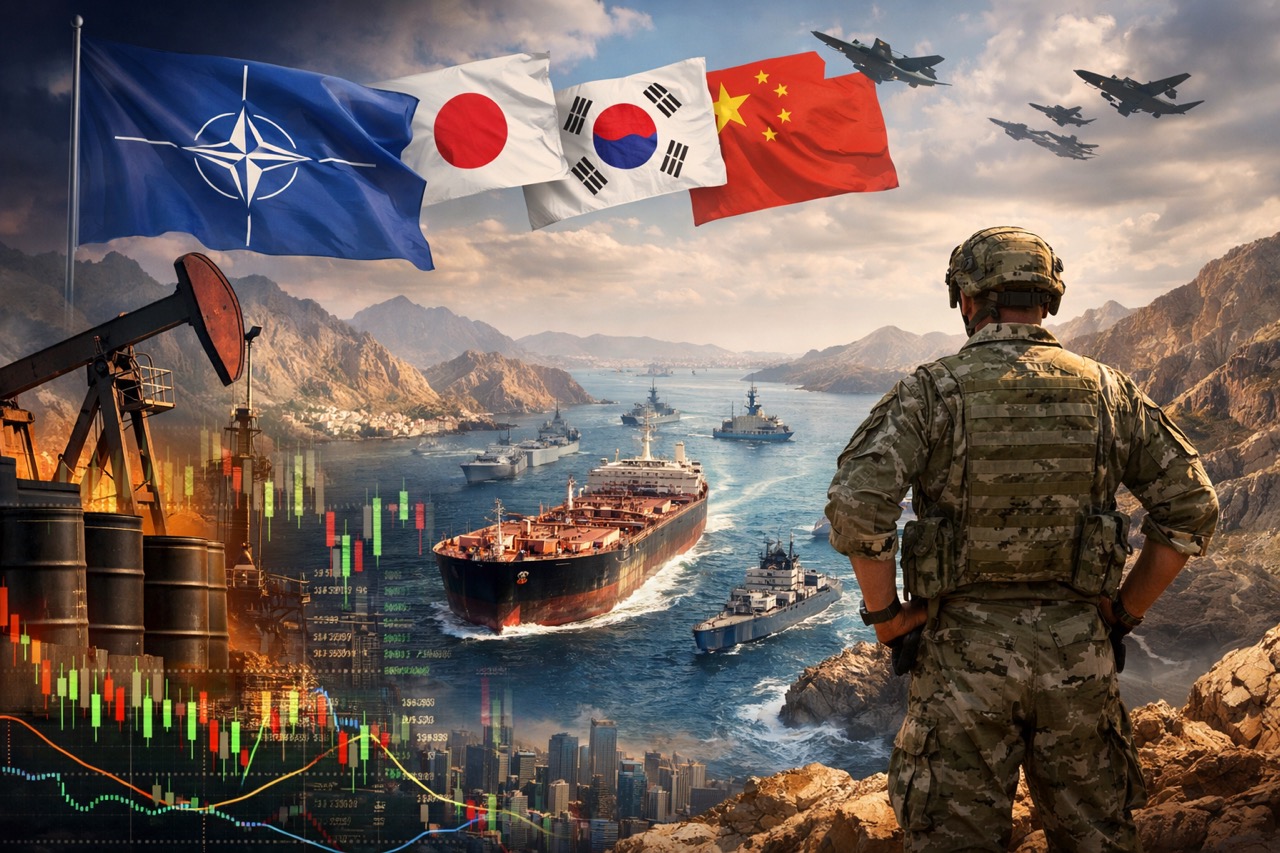
The interests of Asia reinforce that expectation. China, Japan, South Korea, and other Asian economies depend heavily on energy flowing through the Gulf, and they have a powerful interest in keeping that corridor open. A complete shutdown of Hormuz would trigger international pressure very quickly because the stakes are not regional. They are global.
Ultimately, the reason markets did not collapse is not because the war is small. It is because traders believe the war is being controlled strategically. Markets currently assume that the Strait of Hormuz will remain open, that oil supplies will be replaced through alternative production and reserves, that escalation will remain limited, and that global powers will intervene if systemic disruption threatens the world economy. As long as those assumptions hold, markets remain stable.
Another element investors are evaluating is the role of strategic petroleum reserves and how long they can realistically support global markets if the conflict persists. Strategic reserves exist precisely for moments like this: sudden geopolitical shocks that threaten energy supply. The United States maintains one of the largest emergency oil stockpiles in the world through the Strategic Petroleum Reserve, and allied countries coordinated through the International Energy Agency also maintain emergency reserves designed to stabilize markets during crises. Combined, these reserves can release several million barrels per day for a limited period of time.
However, reserves are not a permanent solution. They are designed to provide a bridge, time for markets to adjust, for production elsewhere to increase, and for geopolitical tensions to ease. If the war were to significantly disrupt oil flows for many months, even the largest reserves would eventually decline to levels where governments would have to reconsider how aggressively they continue releasing supply.
Current estimates suggest that the United States and its partners together could sustain a significant emergency release for several weeks and potentially longer, depending on the scale of disruption. The United States Strategic Petroleum Reserve itself holds roughly 350 to 400 million barrels currently available, depending on prior withdrawals. Its maximum release rate is roughly 4 to 5 million barrels per day. At that maximum pace, the U.S. reserve alone could theoretically last around 70 to 90 days, although governments rarely release at the maximum pace for long because they are trying to stretch supply and stabilize expectations, not exhaust their reserves in a matter of weeks.
If combined with IEA member reserves worldwide, coordinated releases could support markets for several months. But not indefinitely, especially if the Strait of Hormuz were completely closed. No reserve system in the world can replace the full volume of oil that normally passes through that corridor for an extended period of time. That is why the real strategy is not to rely on reserves as a permanent answer, but to keep Hormuz at least partially open, increase U.S. production, shift supply routes, and stabilize markets before reserves are depleted.
This is another reason markets have remained relatively calm despite the war. Investors understand that reserves, increased production, and diplomatic pressure can buy time. Financial markets operate on expectations, and the current expectation is that the conflict will not remain at a level that permanently removes a major share of global oil supply. As long as the Strait of Hormuz remains at least partially open and energy producers elsewhere continue increasing output, markets can absorb shocks that would have caused severe crises in previous decades.
The next question, however, is not about oil alone. It is about who is actually helping to protect the system.
President Trump has made clear that countries whose economies depend heavily on the Strait of Hormuz should be helping secure it. Here the facts become very revealing.
France is one of the few European countries actually taking concrete steps, but cautiously. It is actively discussing and preparing naval participation and is already tied to the European maritime mission, Operation Aspides. That means France is moving, but in a defensive and escort posture, not in an aggressive combat role.
The United Kingdom is also moving carefully. London is discussing options and coordinating with allies, but it has not yet committed itself in a fully decisive way. This is a typical British posture in moments like this: close to Washington, strategically aligned, but politically cautious.
Some regional naval actions are also taking place indirectly. Pakistan, for example, has launched a naval protection operation to secure its own shipping routes. That matters, but it also reveals the limitation. Countries dependent on Gulf energy are acting primarily for their own protection, not as part of a unified coalition under American leadership.
Then there is the informal category: countries that Trump mentioned, requested, or pressured. Japan, South Korea, China, France, and the United Kingdom all fall into this wider conversation. Some reports say they may send vessels or are expected to. But that is still political pressure, not confirmed deployment.
The most important part is not who might move. It is who has not moved.
Japan has extraordinary dependence on Hormuz, roughly 95 percent by some estimates, yet there has been no confirmed military deployment. That matters. China, which benefits enormously from Gulf stability and depends heavily on those flows, has not deployed military force either. Its strategy is obvious: benefit from stability while avoiding direct confrontation.
Most of NATO Europe remains slow, fragmented, and cautious. This is exactly the pattern many of us have seen for years. Debate. Delay. Minimal contribution. Concern about the consequences, but reluctance to bear the burden.
This is what the real picture now looks like.
Despite global dependence on oil and despite shared economic risk, the United States remains the main naval power, the main enforcement actor, and the stabilizer of the Strait. That is the fact underneath all the diplomatic language.
Allies are acting, but not as a coalition. There is no real coalition yet. What we see instead is France moving partially, the United Kingdom remaining hesitant, others still waiting, and Asia watching.
This is not NATO unity. This is fragmented reaction.
Markets did not collapse because traders believe the war is being controlled strategically. But that stability rests on a narrow foundation. It depends on the assumption that the United States will continue to secure the world’s most critical energy corridor, that supply can be replaced fast enough, and that escalation will remain contained within limits that no one can fully guarantee.
At the same time, the response of other nations has revealed a deeper imbalance. The global economy depends on the Strait of Hormuz, yet the responsibility for keeping it open is not being shared at the level the situation would demand. The system is functioning, but it is functioning asymmetrically.
If that balance holds, the system continues to function. If it weakens, the consequences will move quickly beyond the battlefield.
That is why the markets did not collapse.
And that is why the situation remains far more fragile than it appears.