
March 17, 2026
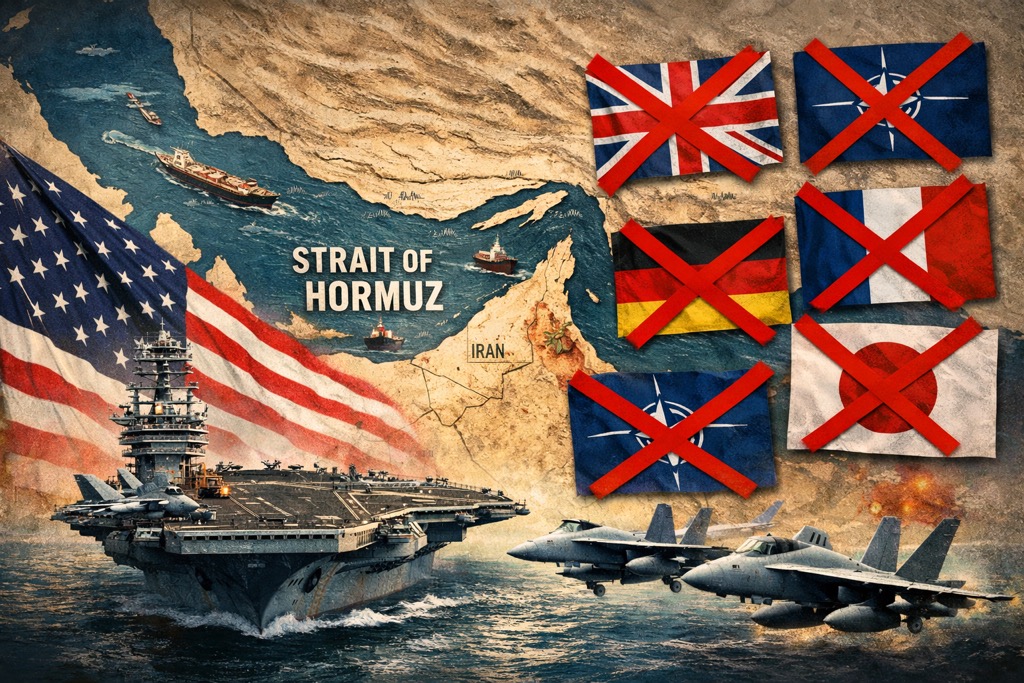
The war involving Iran, Israel, and the United States is widely being described through the language of missiles, airstrikes, and retaliation. That description is incomplete. The center of gravity in this conflict is not located in Tehran, Beirut, or even along Israel’s borders. It is located in a narrow maritime corridor through which the modern global economy breathes: the Strait of Hormuz.
Roughly one-fifth of the world’s oil supply passes through this chokepoint, but the strategic importance of Hormuz goes far beyond oil. The same corridor is critical for petrochemicals, liquefied natural gas, and essential inputs for agriculture, including fertilizers that are directly tied to crop production in major importing countries, including the United States. Any sustained disruption does not simply move energy prices; it transmits pressure into food systems, supply chains, and inflation across entire economies.
That is why this war cannot be understood as a regional confrontation. It is a contest over the stability of the global economic system itself.
There is a growing perception that the United States, under President Trump, may be seeking to take control of Hormuz or even the oil flowing through it. That interpretation misreads the strategy. Trump is not trying to own Hormuz. He is ensuring that no adversary can use it as an economic weapon.
This distinction defines the entire operational logic of the war.
For decades, Iran has treated Hormuz as leverage. The ability to threaten disruption has allowed Tehran to exert influence far beyond its conventional military strength. Markets moved on words alone. Insurance premiums shifted on signals. Governments recalculated based on risk rather than action. That leverage is now being directly targeted.
This is not an operation of occupation. It is an operation of neutralization — the removal of a strategic threat that has shaped global behavior for years.
When the sequence of events is examined carefully, the structure of the strategy becomes clear. The campaign is not random. It follows a disciplined progression: degrading Iran’s military capability, securing Hormuz operationally, forcing other nations to confront their own dependence on the corridor, and then exiting while maintaining strategic control of the outcome.
This fits a recognizable doctrine: win quickly, stabilize the environment, and leave before escalation multiplies risk.
The strikes inside Iran are therefore not symbolic. They are aimed at the architecture of power — missile systems, drone networks, command structures, and the industrial base that sustains them. At the same time, the maritime domain is being secured to prevent Iran from translating pressure into economic disruption.
Parallel to this, a second layer is unfolding — diplomatic exposure. President Trump has called directly on nations whose economies depend heavily on Hormuz to participate in securing it. This is not only a request. It is a test. Japan, China, and much of Europe rely far more on this corridor than the United States does, yet their willingness to act remains limited.
That reality is now visible.
The United States, once again, is carrying the operational burden of a system from which the entire world benefits.
The question of control over Hormuz must also be clarified. Yes, the United States can dominate the Strait temporarily. But that does not mean occupation or resource seizure. It means naval control, minesweeping operations, and the protection of commercial shipping lanes. It means ensuring continuity of flow, not ownership of supply.
Control, in this context, is not territorial. It is functional.
Former National Security Advisor John Bolton recently pointed to a tension that has existed for years. Iran’s ability to close Hormuz was long treated as a deterrent — a reason to avoid direct confrontation. The current strategy reverses that logic. Instead of avoiding the risk, it seeks to eliminate it.
That is a strategic shift with long-term implications.
It carries risk. But it also creates the possibility of removing one of the most persistent sources of instability in the global system.
There is also a broader pattern emerging that should not be ignored. This is not simply a military confrontation. It is a convergence of forces: military dominance by the United States and Israel, visible weakening of Iran’s strategic network, and hesitation from other global actors.
Power, opportunity, and vacuum are aligning.
When that happens, outcomes accelerate. But so does risk.
The critical question now is not whether Iran has been weakened. That is already evident in the degradation of its capabilities. The real question is whether the conflict will now be contained and stabilized, or allowed to expand into something larger.
If the United States secures Hormuz, stabilizes energy and commodity flows, and exits while maintaining strategic advantage, this will be understood as a decisive and controlled operation. If the war continues without clear boundaries, the same success could become the foundation for broader instability.
This moment demands clarity.
This is not a war about oil ownership. It is a war about control over the conditions under which the global economy functions — energy, food, transport, and financial stability.
President Trump is not trying to take Hormuz. He is removing its use as a weapon.
That is why the strategy is working.
And that is why the outcome of this phase will shape far more than the battlefield.