
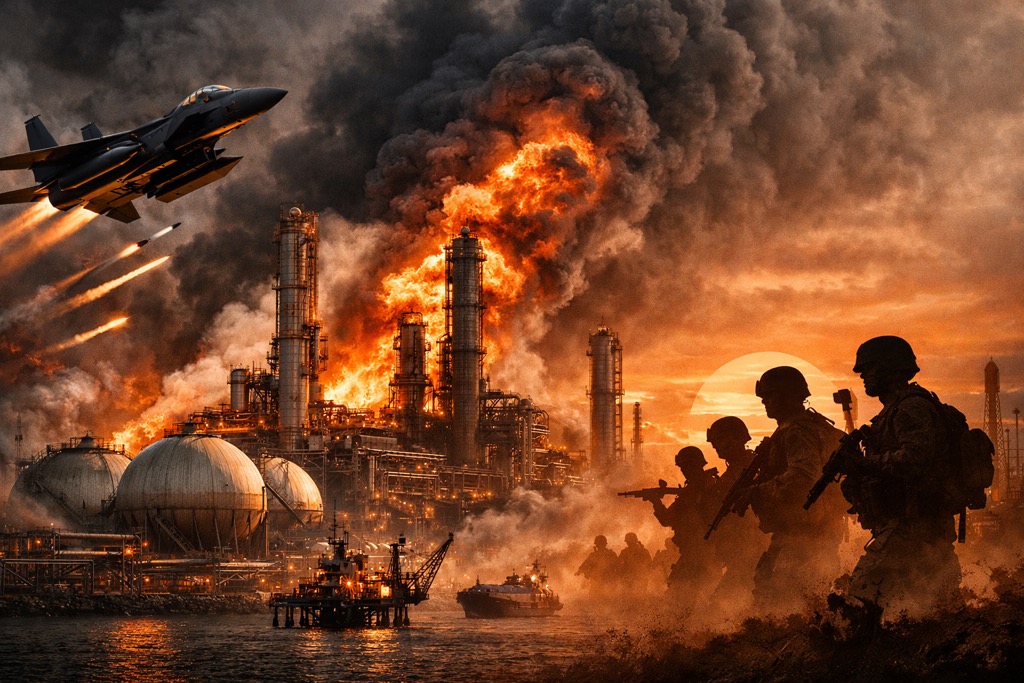
This war has now entered a phase that is far more dangerous than anything we have seen so far, and it is no longer possible to describe it as a contained military confrontation between Iran, Israel, and the United States. What unfolded today is not simply escalation; it is a structural shift that is pulling the entire regional and global system into the center of the conflict.
Three major reactions emerged at the same time, and the timing is not coincidence; it reflects a convergence of developments that reveal a deeper shift in the nature of the conflict, showing that the war has now moved into a second and more complex layer. President Emmanuel Macron called for an immediate moratorium on strikes targeting energy and water infrastructure. The Saudi Foreign Minister confirmed that refineries in Riyadh had been hit and warned that such actions would have consequences. At the same time, President Trump signaled limits around the South Pars escalation, making clear that certain lines should not be crossed.
When these three signals appear simultaneously, they reveal something deeper than battlefield movement. They show that the war has moved into a second layer, one that is no longer only military but systemic.
Until now, energy infrastructure had been discussed as a potential risk. Today it became reality. Gas facilities in Iran were struck. Gulf energy sites were hit in response. Governments that had been cautious are now speaking openly. This is the moment when the conflict stops being theoretical in economic terms and becomes operational.
France is not speaking as a neutral observer. It is reacting as a system under exposure. When Macron calls for the protection of energy and water infrastructure, he is expressing economic alarm. European economies depend on stable energy flows, and what is being threatened now is not only supply but predictability. Markets can absorb risk, but they cannot absorb this level of uncertainty without consequences.
Saudi Arabia’s position marks an even more significant shift. Until now, the Gulf states attempted to remain cautious, balancing between pressure and neutrality. That position becomes difficult to sustain once infrastructure inside their own territory is targeted. Oil production is not only an economic variable for Saudi Arabia; it is tied directly to national stability. When refineries are hit, the issue moves beyond regional politics and becomes a question of internal security.
The statement that “this has consequences” must be understood in that context. It is a warning that the Gulf may be moving from observer to participant if the pressure continues.
This is the most dangerous transition point in any conflict. When both sides gain the ability to affect the global system, escalation is no longer contained. Before today, the pressure was asymmetrical, with Israel and the United States striking Iran’s military and strategic infrastructure. Now the pressure has become symmetrical in one critical domain: energy.
Iran is no longer responding only through military means. It is extending the conflict into economic disruption. This is not an attempt to win on the battlefield; it is an attempt to stretch the system until the cost of continuation becomes unbearable for others.
President Trump’s position must be understood in this light. His signaling is not about defending Iran or restraining Israel in isolation; it is about preventing a total breakdown of the energy system. He is drawing a line not around territory, but around systemic stability. That is a different category of decision, one that recognizes that once energy infrastructure is fully drawn into the conflict, the consequences extend beyond any single nation.
At the same time, another development reinforces the seriousness of this moment. The Pentagon is requesting an additional 200 billion dollars in funding for the continuation of the war. This is not a technical adjustment; it is a strategic signal. Large-scale funding of this magnitude does not accompany short, contained operations. It indicates preparation for sustained engagement.
That raises a critical question. If the original objective was to degrade Iran’s strategic capabilities, and that objective has largely been achieved, then what is the purpose of extending the conflict into a longer and more expensive phase?
This is where the war clearly divides into two layers.
The first layer was the initial campaign: fast, targeted, and strategically effective. The second layer is what is now unfolding: a prolonged phase in which military pressure, economic disruption, and political reactions begin to interact in ways that are harder to control.
The danger is not that the war is being lost. The danger is that the conditions for escalation are expanding beyond what the original objectives required.
This shift is now reinforced by developments within the alliance system itself. Senator Lindsey Graham publicly criticized European allies for their reluctance to contribute military assets to secure the Strait of Hormuz, stating that there would be wide and deep consequences for such hesitation. He described a conversation with President Trump in which the level of frustration was unusually high.
At the same time, President Trump made his position explicit, stating that most NATO allies had indicated they did not want to become involved in the military operation, despite agreeing that Iran must not obtain nuclear weapons. He went further, declaring that the United States does not need, nor desire, NATO assistance and emphasizing that it never truly depended on it.
Germany’s defense minister reinforced that reality by stating openly that this is not Germany’s war. Japan, Australia, and South Korea have also shown reluctance to participate directly.
These are not interpretations; they are now stated positions.
This reveals a structural truth that has long existed but is now fully visible: the global system depends on shared infrastructure, but the responsibility for securing it still falls overwhelmingly on the United States.
What is unfolding is therefore not only a war between adversaries. It is also a test of the alliance system itself.
At the same time, Iran’s strategy has become clearer. By extending pressure toward Gulf energy infrastructure, Tehran is attempting to force regional actors into a position where neutrality becomes impossible. If Gulf states believe they will be targeted regardless of their stance, they are pushed toward choosing sides.
This is a high-risk strategy. It can increase pressure on the United States, but it can also accelerate alignment against Iran.
The result is a convergence of pressures: military, economic, and political, all interacting simultaneously. This convergence is what makes this phase fundamentally different from the earlier stages of the war.
The critical issue is no longer who is winning militarily. The issue is whether the system holding the region together can withstand the pressure being applied to it.
This is why today matters.
It marks the moment when the war stopped being contained between adversaries and began to draw the entire energy system into its center. Once that threshold is crossed, every actor in the region is forced to make decisions that cannot be delayed.
And when that happens, the pace of history changes.
And it will change prophetically.
This is the hour to stand alert, and for the Church to pray with clarity and strength — because what is unfolding now is not simple, and what comes next will require more than strategy alone.