
March 21, 2026
We have entered a moment that is no longer defined only by headlines, but by a narrowing window of consequence. In the last day, the war has expanded in scope, in reach, and in risk. Southern Israel has absorbed one of its most painful nights of this phase of the conflict, with Iranian missile strikes hitting Arad and Dimona and injuring dozens, including several in serious condition. Israeli officials have acknowledged failures in air defense interception, and Prime Minister Benjamin Netanyahu has described it as a very difficult evening in what he called “the campaign for our future.”
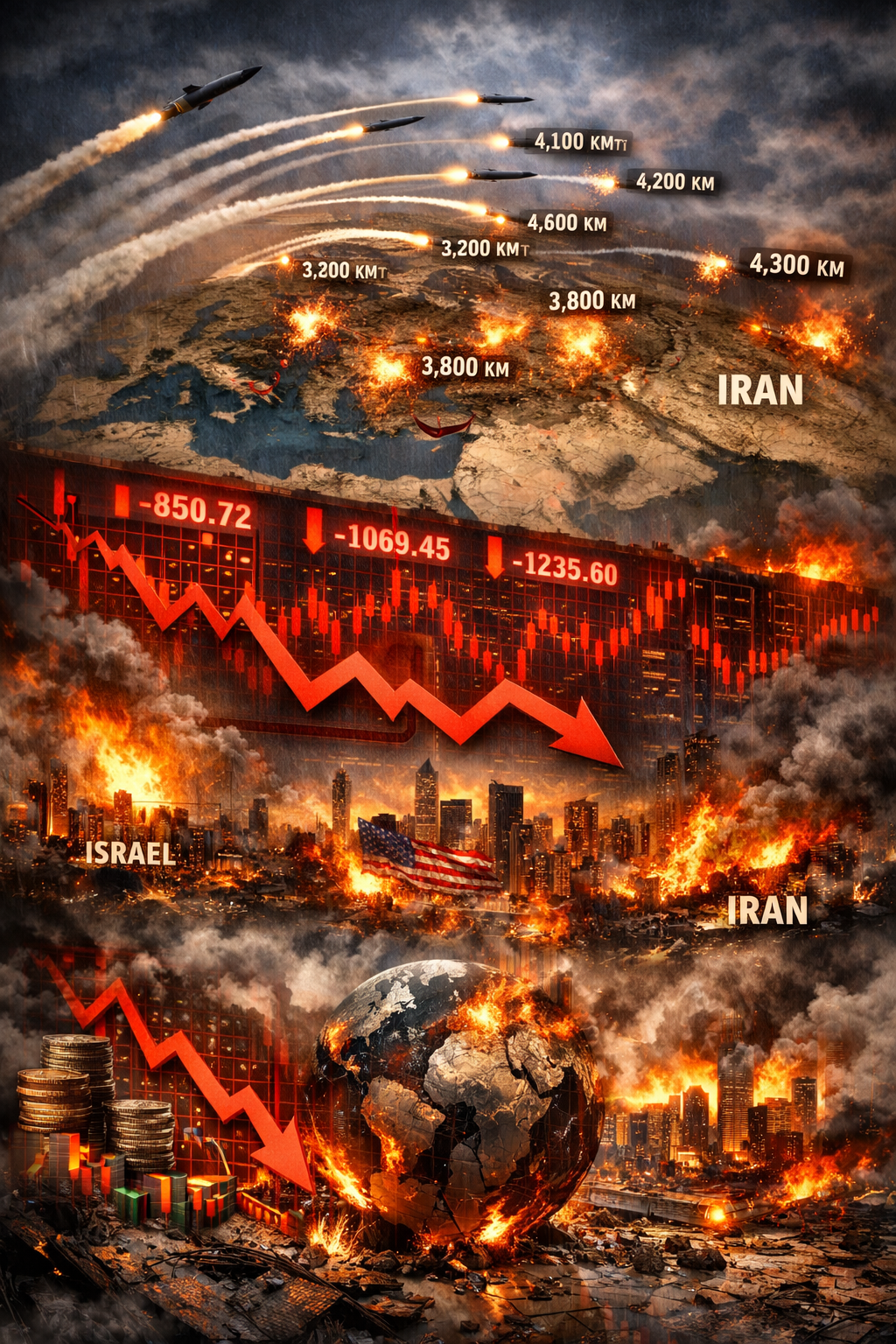
At the same time, Iran attempted something that changed the way this war must now be understood. It launched long-range missiles toward Diego Garcia, the U.S.–U.K. base in the Indian Ocean. The missiles did not hit their target, but that does not make the event insignificant, because it signals that the conflict is no longer confined to the traditional geography of Israel, Lebanon, Gaza, Syria, Iraq, or the Gulf, and that the perimeter of this war is widening.
Into this already expanding situation came one of the most consequential political statements of the day, as President Donald Trump publicly warned that if Iran does not fully reopen the Strait of Hormuz within 48 hours, the United States will take direct action against Iranian power infrastructure, beginning with the largest facilities, a statement that introduces a defined timeframe and a defined consequence.
The Strait of Hormuz is not simply a regional concern, but one of the most critical arteries of the global system, and when that flow is threatened the effects move immediately into markets, shipping, and daily life across nations. What is at risk now is not only military escalation, but systemic disruption, and this is no longer theoretical because it has already begun to move through the system in real time.
Markets are already reacting. Bitcoin has already dropped following President Donald Trump’s announcement, and that movement is not about cryptocurrency itself, but about confidence, because when pressure reaches this level, capital moves immediately, and the reaction we are seeing is the beginning of a much larger shift.
What begins in financial markets does not remain there. It moves through energy, through transport, through supply chains, and into daily life. Energy prices begin to rise, shipping routes become more expensive, insurance costs increase, and supply chains tighten, and from there the pressure reaches households, affecting fuel, food, transportation, and the cost of living across nations.
The movement has already started, and once it begins, it does not stay contained. It spreads across systems that are tightly connected, and what starts in one critical point—like the Strait of Hormuz—multiplies across sectors and across continents.
If this trajectory continues, the consequences move beyond volatility into sustained strain, with rising energy costs, pressure on food supply as agriculture depends on fuel and transport, disruption in the movement of goods, and increasing cost of living across economies. Over time, that pressure weakens growth, tightens systems, and places stress on households and governments at the same time.
At the same time, the broader reality is becoming clearer.
In short, the Islamic regime is threatening to go after the Gulf states energy and water. Gulf states will soon have no choice but to enter. The Islamic regime is ready to be martyred.
I hope the Gulf states, Europe, the United Kingdom, and NATO realize that sooner or later they will need to join. It is either they do the slow drip, or get it over with very quickly. They are already involved, but many don’t want to admit it. The Islamic regime is a threat to the world, not just Israel.
All of this is unfolding within a defined forty-eight-hour window, during which Iran will decide whether to adjust or continue its course, the United States will decide whether to act on its ultimatum, and Israel will continue its operations under increasing pressure, with decisions being made quickly and carrying consequences that extend far beyond the immediate situation.
There are also those who look at this moment through the lens of prophecy, connecting it to Ezekiel and to the return of Jesus, and while that expectation is real and taken seriously, the Word itself requires precision, because Ezekiel describes a condition in which Israel is dwelling securely and at rest, which is not the condition we are witnessing now, and Jesus Himself said there would be wars and rumors of wars, but that this is not yet the end, and so we do not call this fulfillment.
We pray for Israel, for the protection of civilians and for wisdom, clarity, and strength for Prime Minister Benjamin Netanyahu and those leading the nation in this moment, because “He who keeps Israel will neither slumber nor sleep” (Psalm 121:4).
We pray for the United States, for President Donald Trump and for those around him who are making decisions within this narrow window, that those decisions will be guided with discernment, precision, and restraint where needed, because “if any of you lacks wisdom, let him ask of God” (James 1:5).
We pray for Europe, for the United Kingdom, and for the Gulf states, because what is unfolding will affect them directly, whether now or very soon, and we remember that “righteousness exalts a nation” (Proverbs 14:34).
We pray for the global system itself, because the consequences of what is happening will move through economies, supply chains, and into daily life around the world, and we stand on what is written: “God is our refuge and strength, a very present help in trouble” (Psalm 46:1).
We are inside a defined window in which the next decisions will shape what comes next for the region and for the global system.
And that is why prayer is needed now, in the name of Yeshua, asking for the mercy of the Lord and for the defeat of the prince of Persia.