
March 20, 2026
Israel can inflict severe damage on Iran. That much is no longer in question. The more difficult issue is whether it can “finish” what it has begun—and, more importantly, what that outcome would actually entail.
If the objective is defined in military terms—degrading Iran’s missile infrastructure, disrupting production capacity, weakening command structures, and limiting its naval reach—then such a goal is within reach. Israel, especially with U.S. support, possesses the operational capabilities to impose significant setbacks, potentially delaying Iran’s strategic programs by years.
Yet this form of success has inherent limits.
Iran’s military architecture was not designed for simplicity or centralization. It is deliberately dispersed, layered, and built with redundancy in mind. This makes it vulnerable to sustained pressure, but resistant to complete elimination. The distinction matters: the system can be damaged extensively, but not easily erased.
The problem becomes more complex when “finishing” is understood in broader strategic or political terms. If the objective extends to regime change in Tehran, or to the removal of Iran as a long-term regional force, then the calculus shifts entirely. Military power, however effective, does not reliably translate into political outcomes. Even Washington’s evolving articulation of its own objectives reflects this uncertainty. What begins as a campaign to degrade capabilities can quickly become entangled in the far less predictable question of what replaces them.
In that sense, Israel may find that the military phase is the more manageable part of the conflict, while the historical phase—the shaping of what follows—is far less controllable. It can disrupt, delay, and impose costs, but it cannot determine who governs Iran, whether its programs regenerate over time, or whether proxy networks reconstitute in new forms.
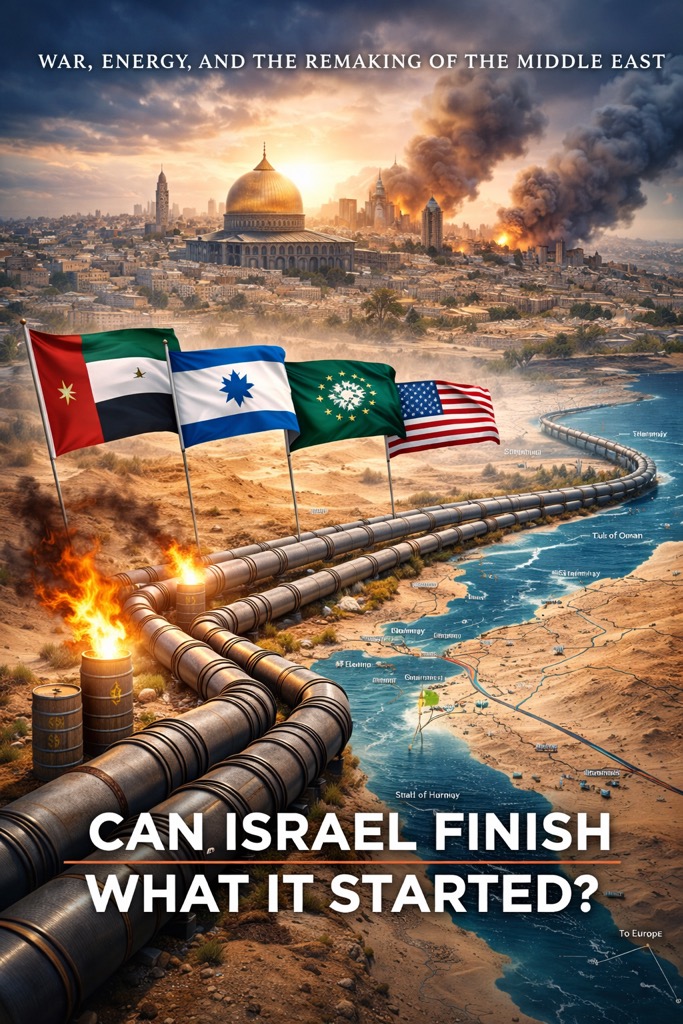
Running parallel to the battlefield, however, is a second development that may prove just as consequential over the long term: the gradual restructuring of global energy routes.
For decades, the Strait of Hormuz has functioned as a critical chokepoint, exerting influence not because it was constantly disrupted, but because of the ever-present possibility that it could be. That latent vulnerability shaped global behavior, discouraging alternatives that would require significant investment or political risk. But once such a chokepoint is actively threatened, the logic changes. What was once tolerated becomes unacceptable.
That transition now appears to be underway.
Gulf producers have already begun redirecting flows through existing alternatives, relying on infrastructure that, until recently, served primarily as contingency. Saudi Arabia’s East-West pipeline and the UAE’s Habshan–Fujairah route illustrate this shift. They do not replace Hormuz, but they reduce dependence on it, and in doing so, they begin to alter the strategic landscape.
Within this evolving system, Israel occupies a position that has been historically underestimated.
The Eilat–Ashkelon corridor, linking the Red Sea to the Mediterranean, offers a potential pathway for energy flows that bypass traditional chokepoints. It is not, at present, capable of absorbing the scale required to meet European demand. But it does not need to function in isolation to be strategically relevant. Its importance lies in its role as part of a broader network—one that includes Gulf pipelines, Red Sea logistics, Mediterranean export routes, and emerging overland corridors connecting Asia to Europe.
This is where the significance of the Abraham Accords becomes impossible to ignore.
Often treated as a diplomatic milestone, the Accords were, in reality, a structural breakthrough. They enabled forms of cooperation that had long been politically constrained, creating the conditions under which integration—economic, logistical, and eventually infrastructural—could begin to take shape.
Before normalization, the idea of routing Gulf energy through Israel faced prohibitive political barriers. After normalization, such discussions became not only possible, but increasingly practical. The Accords did not build pipelines or ports, but they removed the obstacles that prevented those systems from being connected. In that sense, they functioned less as an endpoint and more as an enabling mechanism.
What is now emerging is not a single corridor, but a network designed to distribute risk and reduce dependency on any one route. The more instability affects traditional chokepoints, the more urgency is placed on developing alternatives.
The timing of Prime Minister Narendra Modi’s visit to Israel shortly before the current escalation underscores the broader scope of these changes. India, as a major energy consumer and a key participant in proposed transregional corridors, is not a peripheral actor. Its engagement reflects long-term positioning within a system that is being reconfigured in real time. While there is no evidence linking the visit directly to operational planning for conflict, its strategic context is unmistakable.
At the same time, external powers such as China and Russia are shaping the environment in more indirect ways. China’s interest lies in stability—particularly in maintaining the uninterrupted flow of energy and trade upon which its economy depends. Russia’s position is more complex, benefiting from any situation that divides U.S. strategic attention, while remaining cautious of uncontrolled escalation. Neither power needs to lead this conflict to influence its trajectory. A prolonged but contained confrontation can, under certain conditions, serve both of their interests.
Underlying all of this is a shift in the logic of deterrence itself.
For years, Hormuz functioned as a threat powerful enough to shape behavior without being enacted. Its strength lay in uncertainty—the possibility of disruption, rather than its reality. Once that possibility is tested or partially realized, the equation changes. The threat becomes measurable, and therefore manageable. What was once avoided at all costs becomes a problem to be solved through engineering, logistics, and military planning.
In that sense, the strategic value of such a chokepoint begins to erode the moment it is used. It does not disappear overnight, but it starts to decline as alternatives are developed and reliance decreases.
The conflict now unfolding reflects more than a series of military exchanges. It marks the collision of long-developing forces: Iran’s gradual expansion of regional influence and military capability, and Israel’s determination to prevent that trajectory from reaching a point of irreversibility.
The outcome is unlikely to be definitive.
Israel can achieve meaningful military results. It can degrade capabilities, delay programs, and reshape immediate dynamics. But it cannot guarantee a final resolution. Iran may emerge weakened, yet still intact as a regional actor. The United States may find itself more deeply involved than initially intended. Russia and China will continue to influence the broader strategic environment without assuming direct responsibility for the conflict.
What is likely to endure are the structural changes now being set in motion.
Energy routes will diversify. Political alignments will adjust. Israel’s role—already central—will expand further, not only in security terms, but as part of the emerging architecture connecting regions, markets, and systems.
The conflict itself will eventually subside.
The systems it accelerates will not.
Because once the map begins to change, it rarely returns to its previous form.