
April 6, 2026
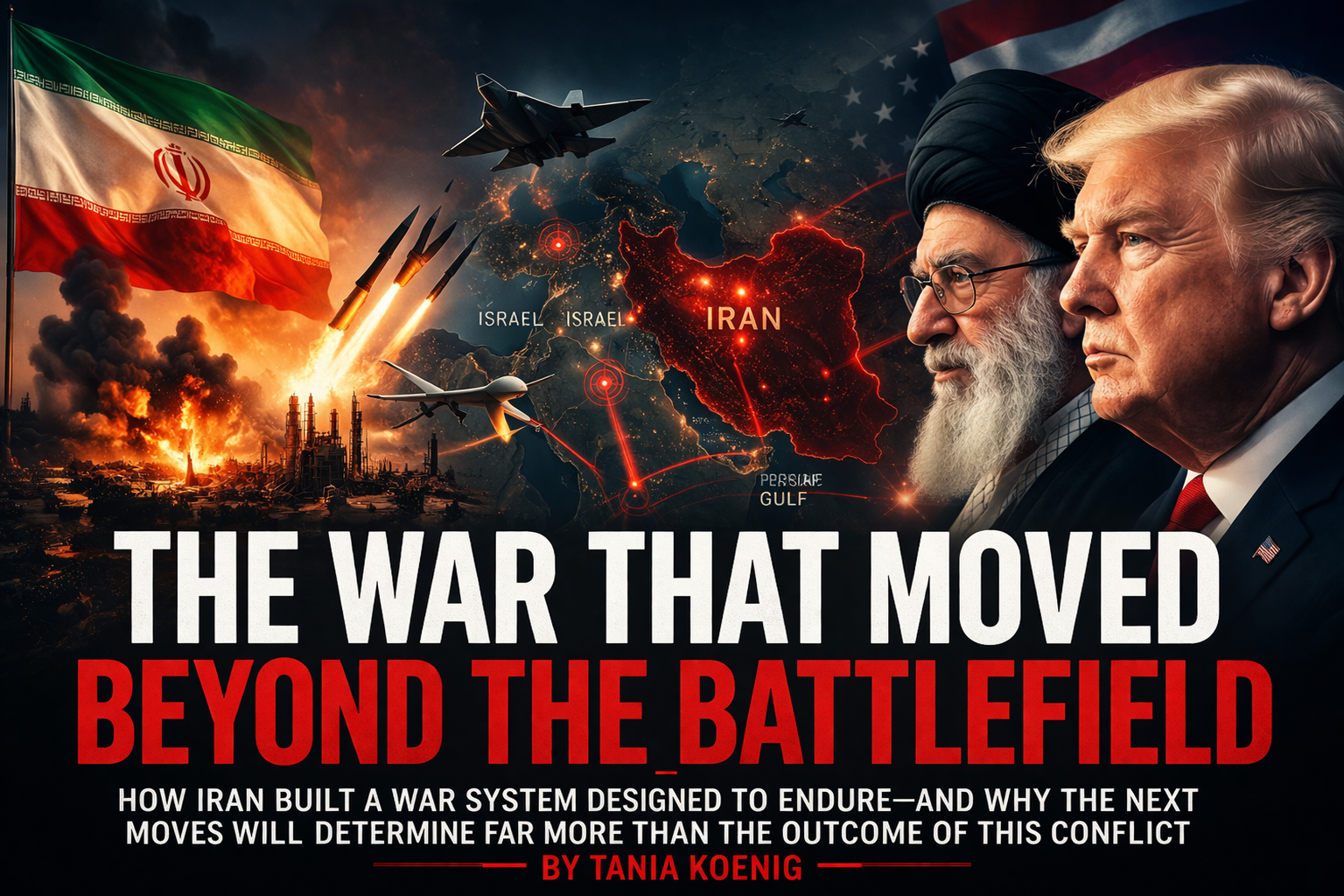
The central mistake in reading this conflict is to continue interpreting it through the framework of conventional war, where sustained strikes, degraded assets, and disrupted command structures are expected to produce a decisive outcome. That framework assumes that pressure accumulates toward collapse. What is unfolding no longer follows that logic, not because military power has failed, but because the system it is being applied against was never designed to collapse under those conditions.
Iran did not construct its military architecture to deliver a clean battlefield victory, nor to mirror technologically superior forces in a symmetrical contest, but to ensure that no amount of external pressure could terminate the conflict quickly or destabilize the regime in a decisive way. The structure now being tested was built over decades with a singular objective: to survive sustained bombardment, leadership targeting, internal unrest, and prolonged psychological pressure without losing operational continuity. What appears externally as persistence is, in fact, the expected expression of that design.
The doctrine often described as Mosaic Defense is therefore not limited to battlefield tactics but should be understood as a regime survival model in which military capability, internal control, and political endurance are fused into a single system. Power is deliberately distributed, command is partially delegated, infrastructure is hardened and buried, and capabilities are dispersed across multiple nodes so that the loss of any single element does not produce systemic failure. Damage, in this structure, is not prevented; it is absorbed and operationalized as part of the system’s endurance.
This is why the continued ability of Iran to launch coordinated salvos after weeks of sustained strikes cannot be read as recovery or resurgence, but must be understood as confirmation that the system is functioning as intended. In a conventional structure, repeated strikes would degrade operational capacity to the point of paralysis or compel behavioral change. In this structure, degradation is anticipated and incorporated into the logic of continuity, allowing the conflict to extend beyond the expectations of those applying pressure.
At the center of this system stands the Islamic Revolutionary Guard Corps, supported by the Basij and reinforced through proxy networks and auxiliary forces. These are not interchangeable formations but components of a layered coercive architecture designed to preserve regime control internally while projecting pressure externally. The IRGC governs escalation logic, strategic strike capability, and regime continuity, while the Basij extends that control into society through surveillance, mobilization, and enforcement. This fusion ensures that the system can continue to function even when individual components are degraded.
Beneath this hardened core lies the conventional military establishment, the Artesh, whose institutional character differs in ways that are strategically significant. It is more professional than ideological, more aligned with the state than with the revolutionary project, and therefore represents a variable that cannot be fully controlled under conditions of prolonged pressure. This distinction reflects a structural tension within the Iranian system between institutions built for national defense and those built for regime preservation.
This internal differentiation reveals the regime’s deepest vulnerability. Iran’s leadership has prepared extensively for external attack, constructing redundancy, dispersing assets, and ensuring that coercive power can survive initial strikes. What it cannot fully guarantee is the long-term cohesion of all elements of its security apparatus if pressure converges with internal unrest. The regime’s greatest fear is not the destruction of infrastructure, but the fracture of control.
For this reason, the conflict cannot be understood as a contest of military strength alone. Iran is not attempting to defeat its adversaries in a decisive engagement, but to extend the conflict until the political cost of continuing exceeds the strategic value of finishing it. The battlefield is only the first stage of that process. The conflict is designed to migrate into the political systems of its opponents, to exploit divisions, generate fatigue, and erode the will to sustain pressure.
What has changed in the last hours is not simply the intensity of the conflict, but the level at which it is operating. The war is no longer confined to military targets and operational exchanges. It is beginning to interact with the systems that sustain it, including energy infrastructure, strategic chokepoints, and the broader conditions of regional stability.
This shift introduces a new dimension to the decisions now being made. The United States is no longer deciding only whether it can act, but what kind of conflict its actions will produce once those actions extend beyond military targets into infrastructure that supports the regional system. Targeting military capabilities allows a degree of containment to remain in place, even under pressure. Targeting infrastructure alters that containment, extending the conflict into a domain where consequences cannot be confined or easily reversed.
At the same time, this external pressure interacts with the internal dynamics of the Iranian system, where resilience is matched by structural vulnerability. The regime’s ability to absorb external damage depends on its capacity to maintain internal cohesion, and that cohesion is not uniform across its institutions.
What emerges from this convergence is not a linear progression toward resolution, but a condition in which the conflict is pressing against the limits of the system that contains it. The outcome will not be determined by the accumulation of strikes alone, but by whether the system can be pushed to a point where it can no longer sustain the interaction between external pressure and internal stability.
This is why the war cannot be understood as failing to end, but must be understood as having been designed not to end quickly, with the outcome determined not by a single campaign or decisive strike, but by whether the structure that sustains the conflict fractures before the will to continue it is exhausted.
We therefore stand in recognition of the gravity of this hour, asking that those who act do so with an understanding of what cannot be undone once it is set in motion. And we ask, in the name of Yeshua, that what seeks to break beyond its bounds be restrained, and that the purposes of God prevail over the designs of men.