April 13, 2026
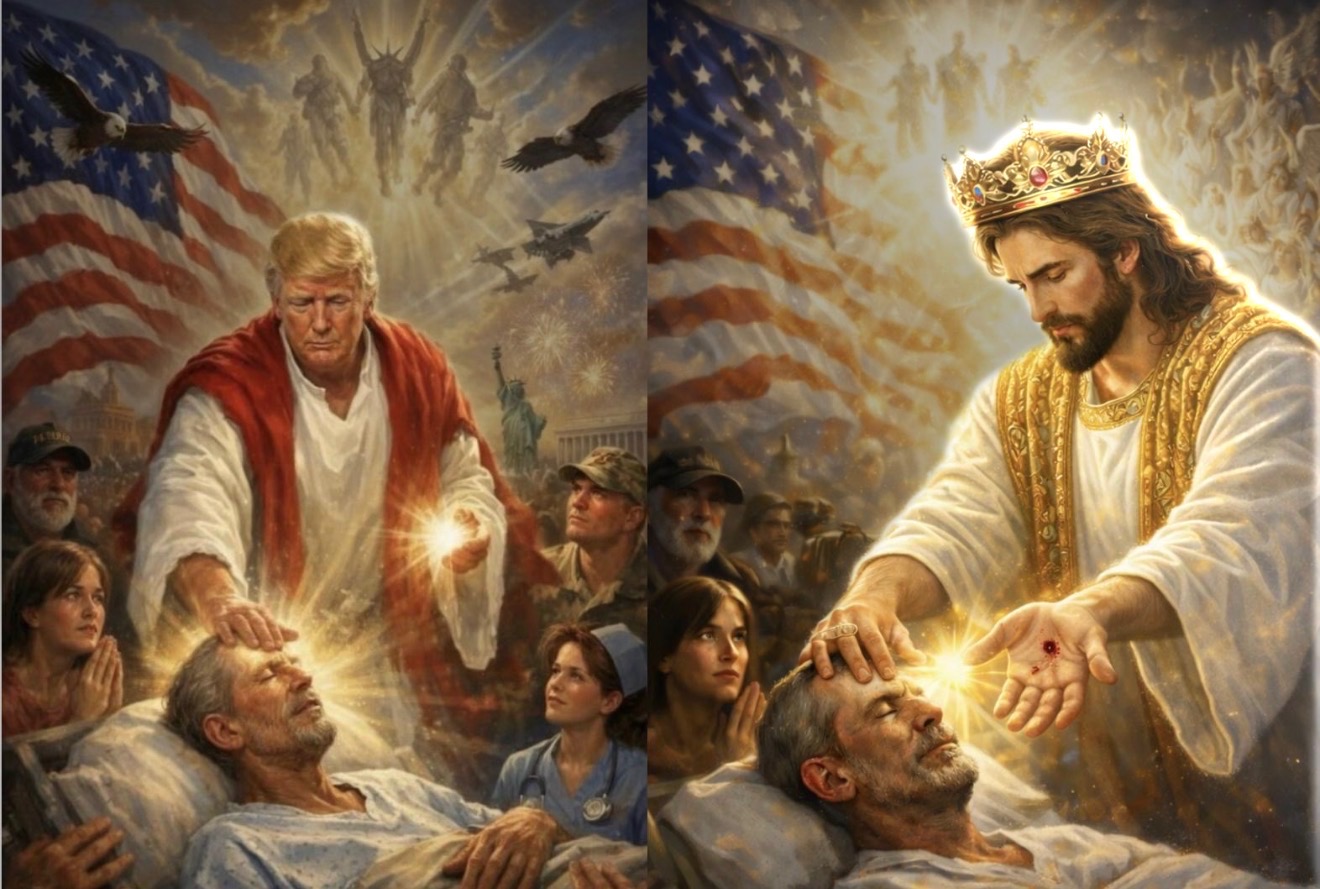
The worldwide reaction to the image of Donald Trump praying for the sick, surrounded by light and angels, has been loud, emotional, and politically charged. But the central accusation being made is not political. It is theological. The charge is that the image mocks Jesus Christ.
That is a serious accusation. It should not be made carelessly, emotionally, or by people who do not understand the depth of biblical categories concerning likeness to Christ, the indwelling of Christ, the work of the Holy Spirit, the gifts of healings, or the ministry of angels. If the claim is that the image is inherently blasphemous or inherently a mockery of Jesus, then that claim must be established from Scripture, not from outrage.
And when the matter is examined carefully in biblical and theological terms, especially in the Greek New Testament, the accusation proves much weaker than its critics assume.
The image does not necessarily depict Jesus Christ. It can be read, in fully biblical categories, as the portrayal of a man ministering in Christlike likeness, under the power of the Holy Spirit, in a context where symbolic “help from above” is being suggested rather than a literal biblical scene.
First, the image does not present the necessary biblical identifiers of Jesus Himself. The risen Christ is identified in Scripture by His wounds. In John 20:27, Jesus says to Thomas, “See My hands.” The wounds are not incidental. They are revelatory. They testify that the crucified one is the risen one. Yet the image in question does not display the marks of crucifixion. Nor does it present a crown, whether the crown of thorns associated with the passion narratives or the exalted royal imagery associated with the glorified Christ. The garment shown is generic. No text in the New Testament describes Jesus in such a way that this robe becomes an exclusive visual identifier of Him. It is simply an ancient-style robe, consistent with a broad range of biblical-era or Roman-era imagery. Clothing alone does not establish that the figure must be Jesus.
That matters. Because if the image does not visually establish Jesus by biblical identifiers, then the accusation of mockery already loses its force. One cannot simply assume that any glowing religious image of a man praying for the sick is automatically “Jesus imagery” in the exclusive sense.
The upper portion of the image must also be understood clearly. The figures presented there are not recognizable as biblical angels or part of a defined heavenly vision. Instead, they appear as soldiers, and the central form resembles the Statue of Liberty, a widely recognized symbol of the United States. These elements point directly to national and military imagery rather than to Scripture.
Positioned within light and above the scene, these figures suggest the idea of support or backing from a higher source. When taken together with the American flag, military elements, and the central act of leadership below, the image communicates a blend of patriotism, protection, and leadership combined with the notion of help from above. This is not a biblical depiction of heaven, but a symbolic composition that merges national identity with spiritual language.
Second, the New Testament gives powerful categories for the believer to become Christ-formed, Christ-like, and Christ-expressive. Paul does not use weak language. In Galatians 2:20 he writes, “Christ lives in me.” The Greek is direct: ze de en emoi Christos. En emoi means “in me.” This is indwelling language, operative presence language, inhabitation language. Paul is not merely saying that he admires Christ, imitates Christ, or remembers Christ. He is saying that Christ lives in him.
He intensifies this in Galatians 4:19: “until Christ is formed in you.” The Greek is mechris hou morphothe Christos en hymin. The verb morphoo means to form, to shape, to bring into recognizable contour. This is not superficial ethics. This is inward formation that takes outward pattern. Paul is speaking about Christ taking shape in the believer.
Romans 8:29 says that believers are predestined to be “conformed to the image of His Son.” The Greek is symmorphous tes eikonos tou huiou autou. Symmorphous means sharing form, being conformed to a pattern; eikonos means image, likeness, visible correspondence. This is not minimal language. It means believers are shaped into the image-pattern of the Son.
Second Corinthians 3:18 goes even further: metamorphoumetha ten auten eikona, “we are being transformed into the same image.” Metamorphoumetha is transformation language, not mere imitation. Ten auten means “the same.” Eikon is image. Paul is saying that as believers behold the glory of the Lord, they are transformed into the same image, from glory to glory, by the Spirit of the Lord. That is deep theology. It means that a Christ-like pattern can become visible in the believer without the believer claiming to be Jesus of Nazareth in His unique messianic identity.
John’s writings make the case even stronger. In John 15:4 Jesus says, “Abide in Me, and I in you.” Greek: meinate en emoi, kagō en hymin. The verb meno means remain, dwell, continue in living union. This is covenantal indwelling language. It is not loose association. In John 14:20 Jesus says, “I am in My Father, and you in Me, and I in you.” That is layered indwelling: Father in Son, believer in Son, Son in believer. Then John gives one of the strongest statements in the New Testament in 1 John 4:17: kathos ekeinos estin, kai hemeis esmen en tō kosmō toutō, “As He is, so are we in this world.” Not merely in the world to come. In this world. That is present-tense likeness. It is likeness of life, character, nature-expression, and manifested identity-pattern.
This is why it is theologically shallow to react to such an image as if Scripture never envisioned a believer bearing Christlike expression. Scripture absolutely does.
Third, the healing scene itself does not establish that the figure must be Jesus, because the New Testament explicitly teaches that healing is ministered through the Holy Spirit by gifts given to believers. The issue is not “power through human hands” in some abstract sense. The issue is divine operation by the Spirit through human vessels.
Paul teaches in 1 Corinthians 12 that there are charismata iamatōn, “gifts of healings.” The phrase is plural in Greek, both in gifts and in healings, indicating varieties of gracious empowerments and manifold operations of healing. He also speaks of energēmata dynameōn, workings of miracles. These are not human achievements. They are distributions of the Spirit. First Corinthians 12:7 says the manifestation of the Spirit is given to each one for the common good. Verse 9 speaks of gifts of healings by the one Spirit. Verse 11 says the one and same Spirit works all these things, distributing to each one individually as He wills.
That is the apostolic framework. The healing ministry of the church is not a rival to Jesus. It is the ministry of Jesus continued by the Holy Spirit through the body of Christ.
This is confirmed in Acts. In Acts 3:6 Peter says, “In the name of Jesus Christ of Nazareth, rise up and walk.” In Acts 3:12 Peter immediately rejects autonomous interpretation: “Why do you stare at us, as though by our own power or godliness we had made him walk?” That verse is essential. The apostle denies self-source, not visible instrumentality. In Acts 5:15 even Peter’s shadow is associated with healing expectation. In Acts 19:11 God does extraordinary miracles through Paul. The text is explicit that God is the actor. The vessel remains human; the source remains divine.
The same theological logic is already rooted in the ministry of Jesus Himself. In Luke 6:19, “power went out from Him and healed them all.” In the life of the church, that healing ministry is not abolished; it is extended by the Spirit. Mark 16:18 says believers will lay hands on the sick and they will recover. James 5:14–15 instructs the elders to pray over the sick and promises that the prayer of faith will save the sick and the Lord will raise him up. Therefore, an image showing a man in a healing posture, with visible power or light, is not inherently unbiblical. On the contrary, it falls well within biblical categories of Spirit-empowered ministry, provided the source is understood to be God.
Fourth, angelic presence around a righteous person in prayer or ministry is thoroughly biblical in Scripture. However, in this image, what appears above is not clearly a biblical representation of angels, but a symbolic arrangement of national and military imagery. Therefore, it should not be interpreted as a literal heavenly vision, but as a visual expression of support and protection conveyed through symbolic means.
The image also reflects a broader narrative that has been publicly associated with Donald Trump by various religious voices: the belief that he has been preserved and set apart for a purpose. Following past events in which his life was threatened and he survived, some have interpreted that preservation as evidence of a larger calling. In certain faith circles, figures such as Jonathan Cahn and others have drawn parallels between Trump and biblical leaders, referring to concepts such as the “anointing of Jehu” or the role of King Cyrus—figures in Scripture understood as instruments used by God for specific purposes in history.
Within that context, the image can be read not as a claim to be Christ, but as a visual expression of this narrative: a leader perceived by some as chosen, preserved, and positioned to act with purpose. The act of praying for the sick, combined with national symbols and the suggestion of support from above, reinforces this idea of mission and perceived divine assignment rather than any claim of incarnation.
From a biblical standpoint, nothing in the image necessarily constitutes an act of irreverence or abomination. Scripture itself presents multiple instances in which God raises and uses individuals—sometimes unexpectedly—as instruments to accomplish specific purposes. Figures such as Jehu and Cyrus were not embodiments of divine identity, yet they were described as being anointed, appointed, or used by God within history. The New Testament further establishes that believers may act under divine authority, pray for the sick, and participate in works empowered by the Holy Spirit, without assuming the identity of Christ Himself.
Within this framework, the image does not depict a man claiming divinity, nor does it present an object of worship. Rather, it can be understood as a symbolic portrayal of a leader perceived as being used, preserved, or positioned under divine providence. As such, it does not meet the biblical criteria for idolatry, blasphemy, or any form of theological abomination.
This is why the accusation of mockery fails to prove itself. The image lacks the definitive biblical markers of Jesus. Meanwhile, Scripture offers abundant categories for believers to be conformed to Christ’s image, to have Christ formed in them, to abide in Him, to manifest His life in their mortal flesh, to minister healing by the Spirit through gifts of healings, and to be surrounded by divine activity under God’s authority.
Theologically, then, the image can be read in a different and defensible way: not as a portrayal of Jesus Christ Himself, and therefore not as an intrinsic mockery of Him, but as a symbolic portrayal of a man operating in a Christlike mode of ministry under divine agency.
That is not a political reading. It is a biblical one.
And those who want to condemn the image as mockery must first answer the New Testament itself, which speaks far more boldly about the believer’s conformity to Christ and participation in His ministry than many of its loudest critics seem willing to acknowledge.
We continue to pray for our president Donald Trump, that the likeness of Jesus Christ may increase in him, as the Apostle Paul exhorts, and as the Scriptures teach.