
By William Koenig, White House Correspondent
May 24, 2026
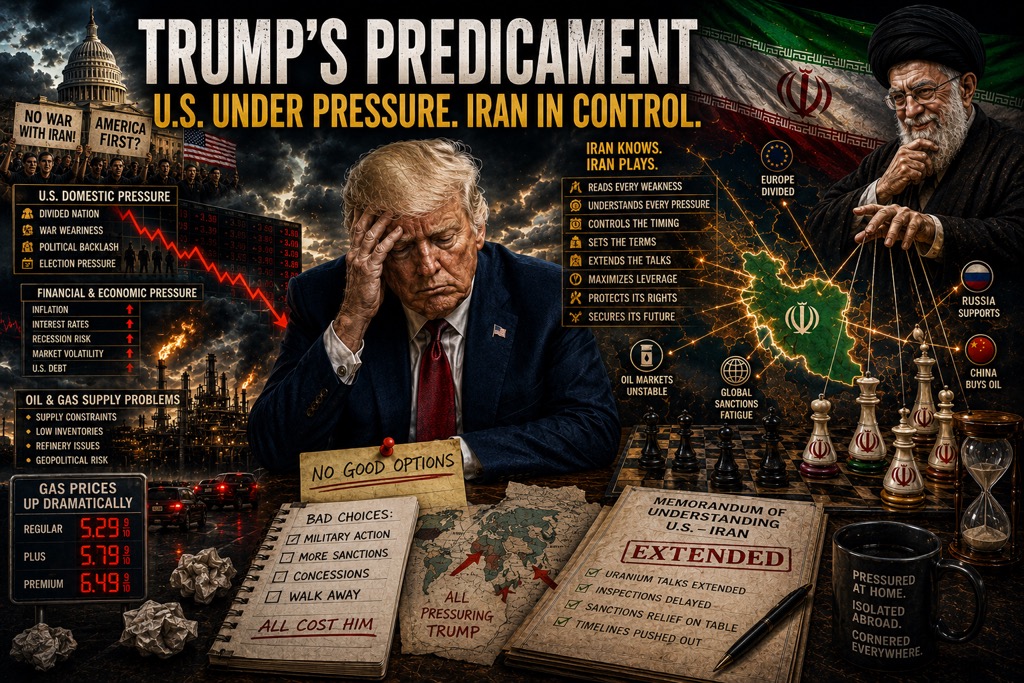
President Trump has been in a very difficult position. He believed he could intimidate Iran, pressure them with threats, and potentially destabilize or remove elements of the leadership. But at the same time, he was facing enormous geopolitical and domestic constraints.
The global economy was already under pressure. Inflation remained elevated. Energy prices were high. Midterm elections were only six months away. The United States was preparing to host the World Cup, and the last thing the administration wanted was to become deeply entangled in a prolonged regional war during such a sensitive period.
Iran understood those pressures.
Despite President Trump’s strong rhetoric and repeated threats, Tehran appeared to conclude that Washington’s room for escalation was limited. Iranian leaders calculated that a broader conflict would become politically costly for the United States and economically destabilizing for the world. From their perspective, time was on their side.
Iran’s strategy seemed clear: prolong negotiations, delay decisions, create uncertainty, agree one day and retract the next, and steadily wear down American leverage. Their objective was not necessarily immediate resolution, but exhaustion — politically, economically, and diplomatically.
At the same time, President Trump faced another major concern: the vulnerability of the Sunni Arab Gulf states.
Countries such as Saudi Arabia, Qatar, and the United Arab Emirates were deeply nervous about Iranian retaliation. One day they supported a tougher American posture; the next day they feared the consequences of escalation.
A major reason was desalination infrastructure.
Roughly 75% to 95% of the drinking water supply in many Gulf nations comes from desalination plants along the Persian Gulf coastline. If Iran targeted those facilities, it could create an immediate humanitarian and economic crisis throughout the region.
President Trump also demanded major concessions from Iran — including the removal of uranium from the country, unrestricted access through the Strait of Hormuz, and some form of international oversight mechanism to guarantee maritime security.
But Iran negotiated from a position of significant leverage. They understood the pressure points: oil markets, shipping lanes, regional infrastructure, water vulnerability, election-year politics, and growing fatigue within Congress over the prospect of another Middle East conflict.
Over time, President Trump’s options narrowed.
And despite the administration’s strong rhetoric and public threats, Iran appeared unconvinced that the United States was prepared to fully follow through militarily under those circumstances.
That is ultimately the core argument of this commentary:
President Trump was out-negotiated. Not because Iran was stronger militarily, but because Tehran successfully leveraged geopolitical risk, economic pressure, regional vulnerabilities, and American political realities to weaken Washington’s negotiating position.