
June 8, 2026
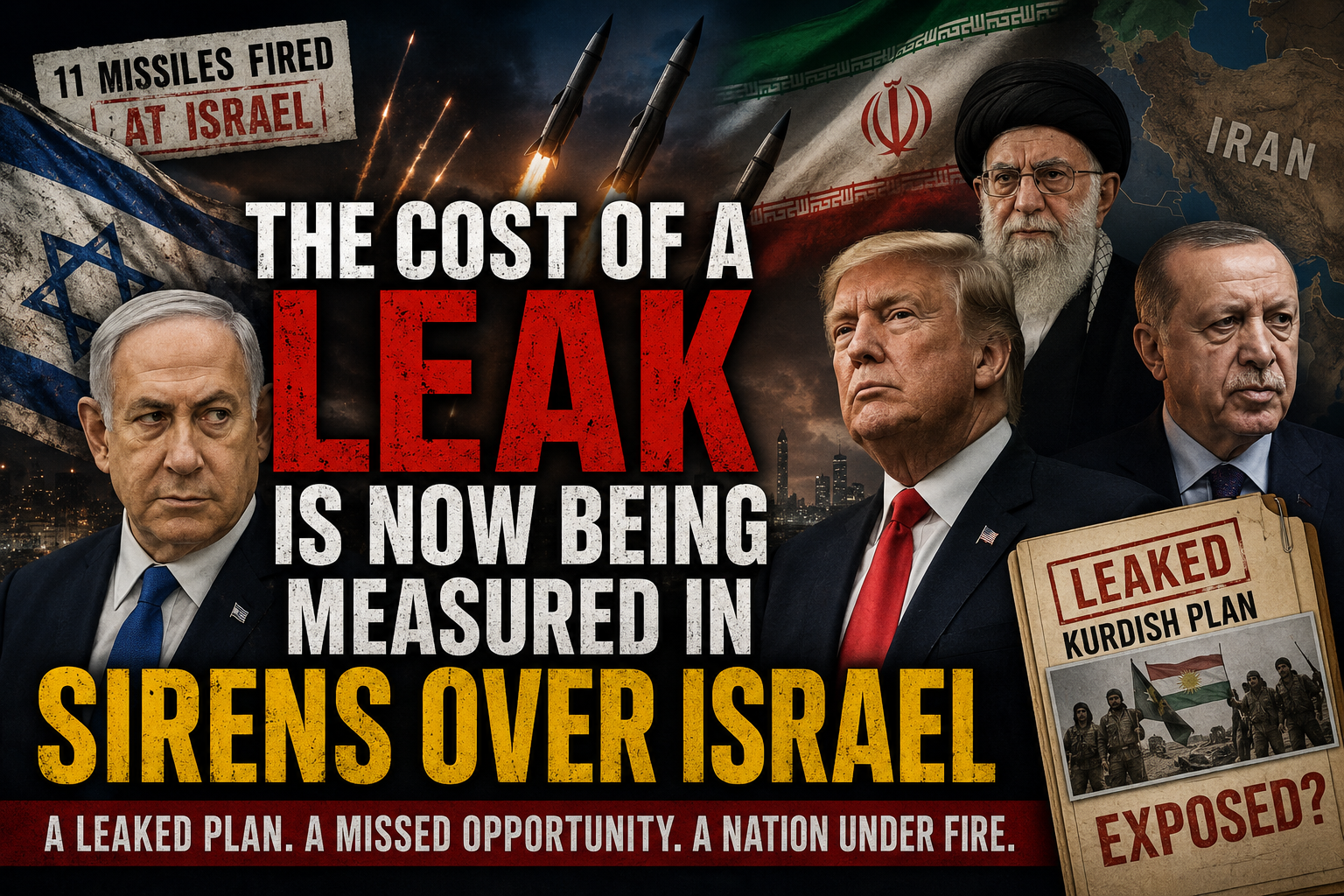
By the end of Sunday night, the story was no longer confined to intelligence briefings, diplomatic channels, or anonymous accusations traded between Washington, Jerusalem and Ankara. It had moved into Israeli homes. Iran had fired ballistic missiles toward Israel for the first time since the April ceasefire, according to reporting from Axios, and Israeli air defenses were activated as civilians were sent into protected spaces. A later report said Iran launched eleven ballistic missiles before Israel struck military targets in western and central Iran, a response also reported by Reuters. What began as an alleged failure of operational secrecy is now being measured in the most concrete terms possible: alarms, interceptions, families in shelters, and a sovereign state forced once again to defend its civilians from missiles launched by the Islamic Republic.
Israeli Ambassador to the United States Yechiel Leiter put the scale of the attack in terms no serious government can ignore. Iran fired eleven ballistic missiles at Israel, he said, and each one of those missiles “can level an entire neighborhood and kill hundreds.” His statement cut through the artificial language that so often surrounds attacks on Israel. These were not diplomatic signals, symbolic projectiles, or controlled gestures of escalation. They were ballistic missiles launched by a hostile regime toward the territory of a sovereign state. Leiter also said Israel was now targeting Iranian surface-to-surface missile launch sites and related infrastructure, while making clear that the strikes were not directed at energy-sector facilities. That distinction matters. Israel is not striking randomly. It is targeting the machinery of missile warfare used by Iran to threaten Israeli civilians.
According to Iranian and regional sources, the Israeli response was broader than a symbolic strike. Reports from inside Iran pointed to roughly twenty targets across the country, including Mehrabad Airport in Tehran, a drone-assembly facility in Najafabad, a Revolutionary Guards complex in Eslamabad, a ballistic-missile site near Tabriz, targets in the western suburbs of Tehran, and additional targets in Isfahan. Major international reporting has not yet independently confirmed every site on that list, but it has confirmed the essential pattern: explosions were reported in several Iranian cities, including Tehran, Karaj, Isfahan, Tabriz and Kermanshah, while Israel said it was striking military targets in western and central Iran after Iran’s missile attack on Israel.
That sequence matters. Iran fired first in this phase, sending ballistic missiles toward Israeli territory and forcing civilians into shelters. Israel then retaliated against the machinery of Iran’s missile and military infrastructure. This is not escalation in a vacuum. It is a state response to a missile attack. Tehran chose to fire outward at Israel, and Israel answered by reaching into the military architecture from which those threats are generated.
In the aftermath of the missile exchange, the confrontation entered a more revealing phase. Israel and Iran both signaled, at least for the moment, that direct strikes had paused after President Trump appealed for restraint. But the pause did not remove the strategic significance of what had just occurred. Iran had shown that it was prepared to fire ballistic missiles directly at Israel in defense of its regional position and its Lebanese proxy architecture; Israel had shown that it would not allow Tehran to impose missile pressure while relying on diplomacy, Hezbollah, or American caution to limit Jerusalem’s response.
This is where the New York Times analysis is useful, but incomplete. Its reporting identifies an important Iranian calculation: Tehran’s current leadership appears to believe that forceful retaliation has helped it survive, regain leverage, and test the distance between American and Israeli objectives. Iranian officials and analysts quoted in that account describe the missile fire not simply as an isolated reaction, but as part of a broader doctrine in which attacks on one component of the so-called Axis of Resistance may be answered beyond the immediate battlefield. In that sense, Iran is not only reacting to events. It is testing the limits of Washington’s restraint, Israel’s freedom of action, and the durability of the U.S.-Israel alignment.
What that analysis does not fully address is the internal-pressure question. If Tehran believes it can use Hezbollah, Lebanon, the Strait of Hormuz, and direct missile fire to shape American and Israeli behavior, then the failure to activate a Kurdish and Iranian opposition front becomes more consequential. The issue is not merely that Iran retaliated. The issue is that Iran retaliated from a position in which one of the few pressure points capable of disturbing its internal stability had not materialized.
That is why the alleged leak remains central to the story. The New York Times describes Iran trying to exploit the gap between President Trump and Prime Minister Netanyahu. The deeper question is whether that gap had already been exploited before the missiles flew. If details of the Kurdish plan reached Erdogan, and if Erdogan’s pressure helped persuade Washington to abandon or restrain the operation, then Tehran’s freedom of action was not created by Iranian confidence alone. It was also shaped by allied incoherence, Turkish pressure, and, if Israeli intelligence sources are correct, a breach of operational secrecy inside Washington.
The latest developments therefore sharpen the original argument rather than replace it. Iran fired, Israel answered, President Trump intervened, and Tehran then framed its missile attack as a doctrine of deterrence on behalf of its regional axis. That is precisely the environment in which the lost Kurdish option matters. Iran is testing whether it can attack Israel, defend Hezbollah, threaten wider escalation, and still induce Washington to restrain Jerusalem. A regime that might have been forced to manage pressure inside its own borders was instead able to negotiate the limits of Israeli self-defense.
The diplomatic pause may lower the immediate temperature, but it does not resolve the strategic failure. A pause after a missile attack is not the same as deterrence. If Iran concludes that ballistic missiles can be fired at Israel and then followed by international pressure on Israel to stop, Tehran will have learned a dangerous lesson. And if the Kurdish option was compromised before it could impose an internal cost on the regime, then the lesson is even more serious: Iran may have retained freedom to fire outward because the front that could have forced it inward never opened.
That is why the reported collapse of the Kurdish option against Iran deserves far more scrutiny than it has received. This is not a side episode in the Iran war. It may be one of the most consequential missed pressure points of the entire confrontation. Reuters had already reported that American and Israeli hopes for Iranian Kurdish fighters to open a front against Tehran collapsed under the weight of mixed signals from Washington, Iranian military pressure against Kurdish positions, and the absence of a coherent strategy. In a separate report, Reuters said Israel had been bombing parts of western Iran in support of Iranian Kurdish militias that hoped to exploit the war and seize towns near the frontier. In other words, the idea was not fantasy. It sat inside the real strategic conversation of the war: could Iran be forced to defend itself internally while it was trying to project power externally?
The answer, in practice, was no. The front never opened. The Kurdish forces stayed out. Tehran was not forced to divide its command attention, intelligence resources, or military pressure between external retaliation and internal vulnerability. The Islamic Republic retained the freedom to look outward, and on Sunday that freedom took the form of ballistic missiles aimed at Israel. The question now is not whether a Kurdish front would have guaranteed victory or regime collapse; serious strategy rarely offers guarantees. The question is whether the very possibility of that front could have imposed costs, uncertainty and fear on Tehran at a moment when every hour of internal pressure mattered.
The most explosive part of the story is the allegation that the option may not have merely failed, but may have been compromised. The Jerusalem Post reported that Israeli intelligence sources accused officials inside the White House of exposing the Kurdish plan to Turkish President Recep TayyipErdogan, with many pointing to Vice President JD Vance. Vance’s office denied the allegation, and that denial must be treated seriously. Public reporting has not established that Vance personally leaked the plan. But the allegation itself is grave because it comes in the context of a known strategic struggle: Turkey opposed any armed Kurdish mobilization, even one aimed at Iran, because Erdogan views Kurdish military empowerment anywhere in the region as a threat to Turkey’s own security doctrine.
If the Israeli-source allegation is accurate, the leak did not merely expose a file or embarrass an official. In wartime, a leak changes the battlefield. It gives another power time to intervene. It converts operational surprise into diplomatic resistance. It allows an ally’s internal division to become an adversary’s strategic advantage. In this case, the alleged disclosure would have given Erdogan the information and the opportunity to press Washington against a move that Tehran itself had every reason to fear. That is why the matter cannot be dismissed as palace intrigue or partisan accusation. If a plan that could have forced Iran inward was exposed before it could be activated, then the cost of that exposure is now visible in Israel’s skies.
Erdogan did not fire the missiles at Israel. Iran did, and the Islamic Republic bears direct responsibility for choosing to launch ballistic missiles at a sovereign nation. But Erdogan’s pressure may have helped keep Iran from facing the internal front that could have limited its freedom to fire them. That distinction is not rhetorical; it is strategic. Turkey did not need to join Iran militarily to help Iran operationally. It only needed to block the Kurdish pressure point. Ankara’s red line became Tehran’s relief valve.
This is the uncomfortable heart of the story. Turkey is a NATO member, but in this episode its overriding priority appears to have been preventing Kurdish empowerment, not weakening Iran’s capacity to threaten Israel. Erdogan could oppose Tehran in some arenas while still protecting Iran from the one kind of instability Ankara fears more: armed Kurdish precedent. For Turkey, the nightmare was not only an Iranian defeat; it was Kurdish forces gaining legitimacy, weapons, battlefield relevance and American-Israeli backing. For Iran, that Turkish fear was useful. It meant that a front Tehran might have had to fight could be strangled before it opened.
The broader Turkish posture toward Israel makes this even harder to ignore. Turkey’s interior minister recently spoke of the “liberation” of Jerusalem and of returning the city to Turkish hands, comments reported by Israeli media and sharply rejected by Israel’s Foreign Ministry. Such language is not the vocabulary of a neutral mediator. It belongs to a neo-Ottoman and Islamist imagination in which Jerusalem is not accepted as Israel’s sovereign capital but treated as an unfinished historical claim. That does not make Turkey identical to Iran, but it does place Ankara’s conduct in a wider regional pattern: Israel’s enemies and hostile interlocutors may differ in ideology, but their ambitions often converge around limiting Jewish sovereignty and Israeli freedom of action.
Leiter’s formulation is also the proper moral test for the international community. If each Iranian missile can level a neighborhood and kill hundreds, then the question is not why Israel responds. The question is what responsible government would fail to respond. The right of self-defense is not theoretical when civilians are being ordered into shelters and ballistic missiles are crossing the sky. It is immediate, legal, moral and necessary. No state is required to absorb ballistic missile fire without response. No government worthy of the name would leave its citizens in shelters while foreign capitals debate whether retaliation might be inconvenient. Israel has the right to strike the launch infrastructure, degrade the missile systems, and impose costs on the regime that fires at its population. The demand for Israeli restraint is morally hollow when it begins only after Iran fires and Israel prepares to answer.
But Israel also has the right to demand answers from its allies. Who knew about the Kurdish option? Who communicated details to Turkey? Was Erdogan warned directly or indirectly? Did Washington halt the operation because of Turkish pressure? Were Israeli operational requirements subordinated to Ankara’s anti-Kurdish doctrine? And if the accusation against Vance is false, why do Israeli intelligence sources believe the plan was exposed from inside Washington at all? These questions are not partisan. They are questions of wartime trust.
The failure of the Kurdish front may have several causes: Iranian deterrence, Kurdish caution, Washington’s mixed signals, Israeli hesitation, Turkish pressure and possibly an unauthorized disclosure. But the result is no longer theoretical. Iran was not forced to defend its own vulnerable interior. Israel was forced to defend its civilians from Iranian missiles. That is the sequence that now demands investigation.
The implications now reach far beyond one failed operation. If the Kurdish plan was exposed from within Washington, this is not merely a political embarrassment or an internal dispute between factions of the American government. It is a federal matter. A wartime leak involving an allied operation, a hostile regime, and a third government with its own regional agenda would represent a breach of trust at the highest level. Israel has the right to demand answers, and the American people have the right to know whether the security of a close ally was compromised while Iran retained the freedom to fire.
President Trump is also facing the limits of a strategy that tries to restrain Israel while negotiating with Iran. That approach becomes increasingly untenable when Tehran answers diplomacy with ballistic missiles, when Hezbollah remains embedded in Lebanon, and when Turkey uses its influence to block the one internal pressure point Iran feared. The problem is not only that Washington failed to control events. The problem is that American caution may have helped create the space in which Iran could escalate and then ask the world to restrain Israel.
This situation will not be changed by diplomatic language alone. It will change when Israel, the ancient and covenant nation, stands with the clarity required of a people under attack. Israel is not required to surrender its security to the calculations of Washington, Ankara, Brussels, or Tehran. It has buried its dead, absorbed its losses, watched its civilians run to shelters, and endured lectures from governments that would never tolerate one hour of what Israel is told to absorb for the sake of “stability.” Israel has the right to rise, to strike, to defend, and to live.
The God of Israel has not failed.
That is not a slogan. It is the deepest reality beneath the headlines. The war against Israel is not only territorial, military, or diplomatic. It is also spiritual. Scripture speaks of the “prince of the kingdom of Persia” resisting the purposes of God, and the present struggle cannot be understood only through the language of missiles, proxies, and negotiations. Behind the visible conflict is a deeper hostility against the covenant, against Jerusalem, and against the people through whom God revealed His name to the nations.
This is why the Church must wake up.
The remnant Church cannot remain passive while Israel stands under fire. This is not the hour for confusion, neutrality, or theological cowardice. It is the hour to discern the battle and to take up the weapons God has given — not the weapons of hatred, vengeance, or fleshly rage, but the weapons of the Spirit: prayer, truth, righteousness, intercession, courage, and the Word of God.
“For though we walk in the flesh, we do not war according to the flesh. For the weapons of our warfare are not carnal, but mighty through God for the pulling down of strongholds.” — 2 Corinthians 10:3–4
Israel’s enemies are firing missiles. Washington is managing optics. Turkey is protecting its red lines. Iran is testing the limits of deterrence. But the God of Abraham, Isaac, and Jacob remains faithful. And when Israel stands, it does not stand alone.