
June 16, 2026
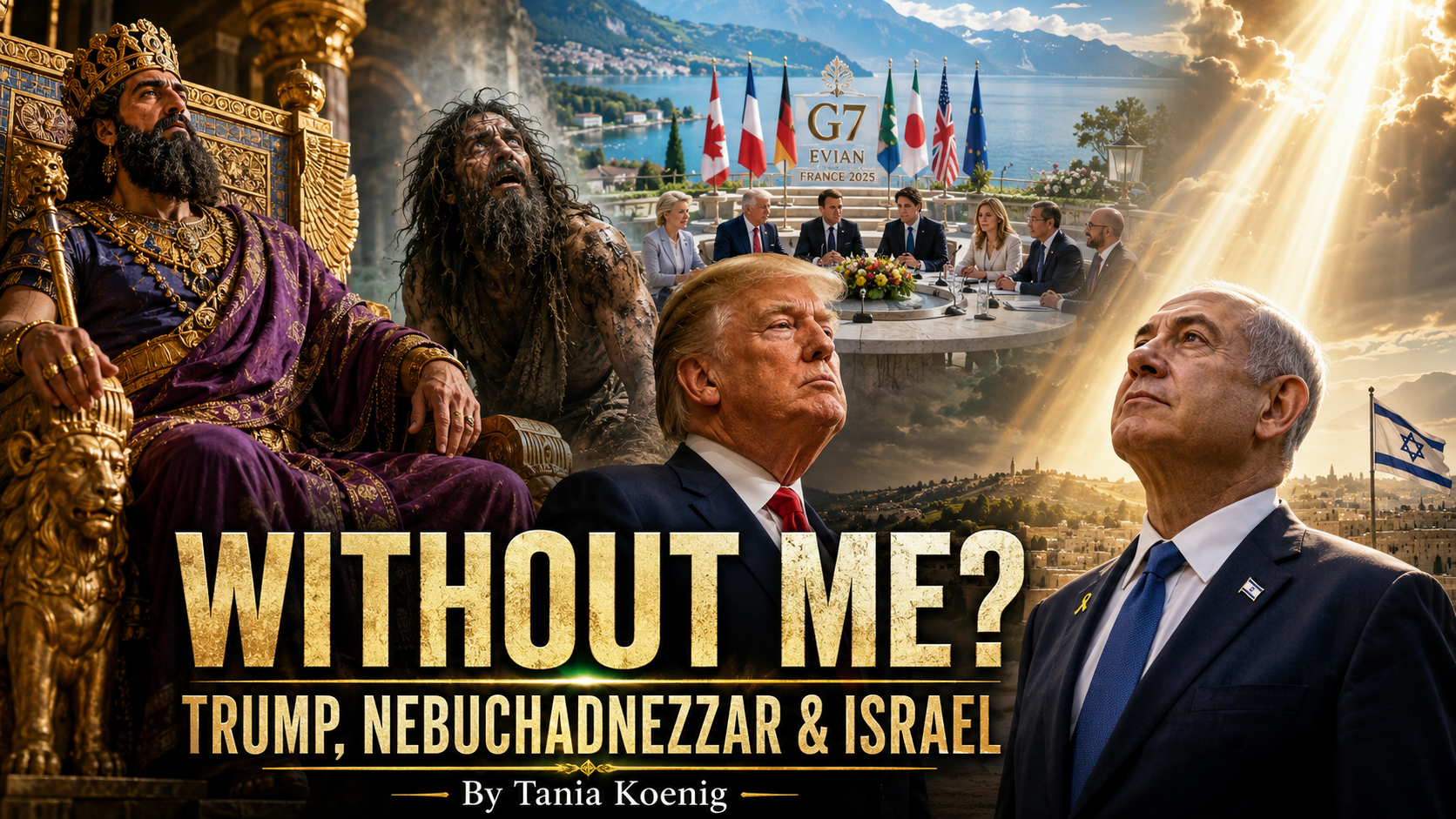
President Trump’s statement at the G7 in Évian-les-Bains, France, may prove more serious than the Iran MOU itself. Speaking before the nations, in the middle of a crisis involving Israel, Lebanon, Hezbollah, Iran, and the future of the region, he said: “Without the United States there would be no Israel. Without me, there would be no Israel.”
Those words cannot be dismissed as ordinary political exaggeration. They cross a line no ruler should approach. Israel does not exist because of a president, an empire, a military alliance, or a diplomatic achievement. Israel exists because the God of Abraham, Isaac, and Jacob keeps covenant. The rebirth of Israel in 1948 was not the result of one man’s ego or one administration’s generosity; it was the fulfillment of the Word of God in history. Leaders and nations may be used as instruments, but no man can claim the glory for what God has promised and performed.
The passage that immediately came to my spirit was Daniel 4. Nebuchadnezzar looked over Babylon and said, “Is not this great Babylon, that I have built for a royal dwelling by my mighty power and for the honor of my majesty?” While the word was still in the king’s mouth, heaven answered. The most powerful ruler of his generation was driven from men, stripped of his dignity, and humbled until he learned that the Most High rules in the kingdom of men and gives it to whomever He wills.
That passage is not ancient history only. It is a warning written for rulers, empires, and nations that confuse stewardship with ownership. Nebuchadnezzar’s sin was not that Babylon was powerful. His sin was that he looked at what heaven had allowed him to govern and spoke as though it existed by his own hand. When a president speaks over Israel as though her survival depends on him, he is not merely exaggerating his record. He is touching the glory of the God of Israel.
The timing makes the statement even more grave. It came while Israel is being pressured over Lebanon, while Prime Minister Netanyahu is being publicly criticized, while Hezbollah remains armed, and while an MOU with Iran appears to give Tehran extraordinary freedom without resolving the core threat. The public language is “peace,” “stability,” “navigation,” and “nuclear restraint,” but the substance points in another direction.
The MOU text circulating through Arab and Israeli channels is deeply troubling. It is not a real deal. It is an intention on paper, and the intention favors Iran. It reportedly ends the war on all fronts, including Lebanon, while placing Israel under pressure to restrain itself. It lifts the naval blockade, restores maritime traffic, allows Iran to resume oil and fuel sales through U.S. Treasury waivers, and points toward a massive economic rehabilitation plan for Iran while the most dangerous issues are left for later.
That combination tells the story: relief now, the most dangerous questions later.
The enriched material, Iran’s nuclear needs, uranium enrichment, and other technical nuclear issues are not resolved immediately; they are pushed into future negotiations. In the interim, Iran keeps the status quo on its nuclear program while the United States promises no new sanctions and no strengthening of its regional forces. If this is the operative framework, it is not Iranian surrender. It is Iranian preservation.
There is also a contradiction inside American law itself. A provision passed by Congress in 2024 reportedly restricts any effort to remove the IRGC from the Foreign Terrorist Organization list for four years after a formal determination that it was involved in drone attacks on Americans, unless the president invokes a national security waiver. That means the MOU may offer Iran a broad path to relief while U.S. law still treats the IRGC as what it is: a terrorist arm of the regime.
This is not a technicality. The IRGC is the engine behind Iran’s proxies, missiles, intimidation, and war against Israel. If the MOU offers Tehran the benefits of normalization while the legal foundation still identifies the regime’s core military structure as terrorist, the contradiction will not disappear. It will become one of the reasons the arrangement cannot hold.
The most dangerous part of this framework is what it postpones. Sanctions are placed on a path toward removal. Oil revenue is revived immediately. Lebanon is folded into the arrangement. Hezbollah remains available as pressure. The Strait of Hormuz is presented as the great diplomatic prize, while Iran’s ability to weaponize that route remains part of its leverage. Tehran does not need to announce a future crisis directly. It has the strait, Hezbollah, the IRGC, and proxies trained to act while the regime preserves formal distance.
Iran does not think like the West. Tehran can sign an understanding while preserving the war. It can speak the language of negotiation while calculating how to survive, rebuild, and reposition. It can allow diplomats to celebrate a pause while its ideological machinery remains untouched. Money entering Iran under this regime does not become moderation. It becomes survival, patronage, weapons, proxies, and renewed capacity.
This is where the people around Trump matter. America is not being guided only by national security doctrine. It is being shaped by dealmakers, financial architects, Gulf channels, investment language, and political figures who believe the Middle East can be managed through personal access, leverage, reconstruction funds, and signatures. Steve Witkoff and Jared Kushner think in terms of packages, incentives, development, and regional arrangements. J.D. Vance gives retreat the language of restraint. That may sound practical in Washington, but it is disastrous when dealing with a revolutionary regime that has spent decades using negotiations to buy time and proxies to wage war.
This money-centered atmosphere was visible even in President Trump’s own language about the UAE president. Reacting to how softly he spoke, Trump said, “See, when you’re that rich, you can speak that low. I was wondering, can anybody hear that? But when you’re so rich, you have such confidence, you don’t have to do any strain to the voice.” The remark may sound casual, but it reveals the diplomatic culture now shaping the region: wealth is treated as authority, money as confidence, and financial power as political legitimacy. That may be how dealmakers read the world, but it is a dangerous lens through which to handle Israel, Iran, Gaza, and covenant land.
Israel is the one being asked to pay the strategic price. Iran receives time. The Gulf receives stability. Markets receive relief. Washington receives an exit document. Israel remains facing the same regime, the same Hezbollah threat, the same IRGC architecture, and the same unresolved nuclear question.
If Tehran wants to escape the MOU, Hezbollah provides the obvious instrument. A serious attack from Lebanon would force Israel to respond, and Iran could then accuse Washington of failing to restrain Jerusalem or claim that Israel destroyed the spirit of the understanding. The proxy carries the operational burden while Tehran keeps its hands formally clean. That is why including Lebanon in the framework is so dangerous. Hezbollah is not an outside complication. It is one of Iran’s strategic hands.
The G7 setting adds another dimension. The most powerful nations gather in France and speak as though the Middle East can be stabilized through frameworks, money, waivers, reconstruction, and global management. This is the same spirit seen in Davos, where Gaza was discussed under the language of international administration, rebuilding, governance, and security. But Gaza is not a development file. Jerusalem is not a negotiable instrument. Israel is not an asset class inside a global stability portfolio. The land belongs under the authority of the God of Israel, and the nations should tremble before treating covenant territory as a management experiment.
The prophetic weight of this moment is not complicated. Iran is preserved. Israel is pressured. Lebanon is absorbed into the arrangement. Oil and the Strait of Hormuz drive urgency. Money becomes the incentive. Arab mediators carry the process. Washington appears willing to restrain Israel in order to protect a document. That movement alone is enough to take seriously.
Trump’s words belong near Daniel 4, not near the covenant promises of God. “Without me, there would be no Israel” is the kind of boast heaven has already answered in Scripture. Nebuchadnezzar learned that the Most High rules over the kingdoms of men. Every ruler who touches Israel must learn the same.
Israel does not exist because of Trump. Israel does not exist because of America. Israel exists because the God of Israel is faithful. The danger now is not only Iran’s deception, Hezbollah’s violence, or the weakness of an MOU. The danger is that a president who once served as an instrument of blessing for Israel may now speak as though he is the source of Israel’s survival.
That is the line no ruler should cross.
The conclusion of this moment cannot be anger alone. It must be intercession. Last night William and I were speaking about the patterns he has documented for years in Eye to Eye — the consequences that follow when leaders pressure Israel over the land God gave her. For the first time, he is beginning to see those patterns emerging inside this administration. That should make every serious believer understand the weight of the hour.
This is not a moment to curse President Trump. It is a moment to pray that he hears the Lord before he touches what belongs to the God of Israel. He has been used in important ways, but no ruler is above correction, and no nation is exempt from consequences when it pressures Israel over covenant land. America needs mercy. President Trump needs to hear God clearly. Netanyahu needs strength. Israel needs protection.
Daniel did not merely analyze Babylon. He prayed. He understood the times, but he also humbled himself before God and stood in the gap for his people. That is the work now. Pray for America. Pray for President Trump, that he will hear the Lord and not be led by pride, pressure, bad counsel, or the money powers surrounding this process. Pray for Netanyahu and for Israel, that the Lord will strengthen them and preserve them. Pray that America remains among those who bless Israel, because the promise still stands: “I will bless those who bless you, and I will curse him who curses you.”
We also see the Democrats rising again and becoming very active this week. That cannot be ignored. As dangerous as this moment is inside the Trump administration, the return of those who are openly more hostile to Israel would bring an even greater danger. This is not a moment for political blindness. America is in a dangerous place. President Trump must be corrected by the Lord, but America must also be protected from leaders who would move even more aggressively against Israel, empower Iran, and abandon the biblical foundations that still restrain this nation.
Prayer is now the work. America needs mercy. Israel needs strength. President Trump must hear the Lord. Netanyahu must stand firm. The future of nations is being weighed.
Prayer is now the key for America.