
July 24, 2026
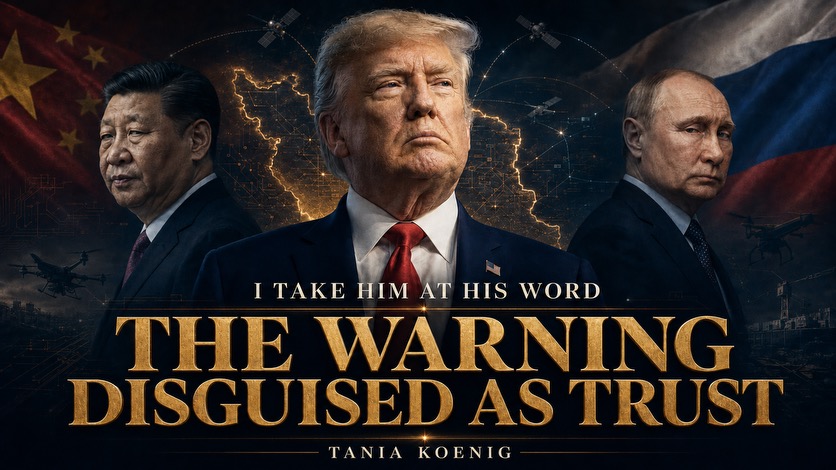
On July 24, President Trump published an extraordinary message on Truth Social directed at Xi Jinping and Vladimir Putin. He said Xi had promised him that China would not, “under any circumstances,” give or sell weapons to Iran, emphasizing that the commitment included Chinese companies. Putin, he said, had given him a similar assurance regarding Russia.
“Therefore, two major Countries that people speak of often in terms of Iran are, in my opinion, not participating. If they did, it would be very bad for them—Certainly not in their best interests.”
Without the complete context, those words could be mistaken for reassurance. President Trump appears to be informing the public that China and Russia have remained outside the war. Yet the construction of the message—and particularly the threat attached to it—points in another direction.
The wrong question is whether President Trump personally believes the assurances he says he received. That reduces a carefully constructed presidential statement to a matter of trust when its real purpose is strategic. In diplomacy, publicly accepting another leader’s word can be more coercive than accusing him of deception. An accusation demands evidence, invites denial and may force the accused leader to resist in defense of his prestige. A publicly accepted promise creates an obligation while leaving him room to comply without acknowledging that he has retreated.
President Trump has taken assurances allegedly made in private and transformed them into personal guarantees before the world. He is not certifying the innocence of Xi and Putin. He is giving them the status of nonparticipants on the condition that they now make that status true.
The message is best understood as an intelligence-informed warning. President Trump knows—or has been briefed—that assistance is reaching Iran through Russian and Chinese channels, but he has chosen not to expose the intelligence, identify every channel or force an immediate confrontation with two nuclear powers. Instead, he has placed responsibility directly upon the two men capable of restraining those channels.
The seventy-two hours behind the statement
The timing is too precise to ignore. Approximately two days before President Trump’s post, Reuters reported that American intelligence analysts were investigating whether Russian assistance had contributed to Iranian attacks on CIA facilities. According to four people familiar with the intelligence, the inquiry involved possible targeting information and advanced drone technology. No final public assessment had been announced, but Washington was clearly examining whether Russian support had entered the operational level of the conflict.
The following day, Reuters reported that a Mahan Air flight had allegedly transported Revolutionary Guard personnel, missile and drone components and gold to the Houthis in Yemen. Iran and the Houthis denied the account, yet the report illustrated the larger reality of the war: operational knowledge, military components and financing can pass through carefully separated channels while every government involved denies direct participation.
At the same time, the United States conducted its eleventh, twelfth and thirteenth consecutive nights of strikes against Iranian command centers, air defenses, missile and drone infrastructure, military logistics and maritime capabilities. Iran continued retaliating across the region, while Houthi actions against Saudi shipping increased the pressure on Bab el-Mandeb alongside the severe disruption already affecting the Strait of Hormuz.
The conflict was expanding beyond the visible exchange of fire between Washington and Tehran. Its continuation increasingly depended upon the external architecture surrounding Iran: access to technology, targeting information, replacement components, financial channels and proxy networks. President Trump’s statement appeared precisely as that architecture was becoming more visible.
The absence of a final public intelligence judgment does not weaken this interpretation. Presidents routinely act upon information that cannot be fully disclosed because it remains incomplete, because its origin is classified or because revealing it would compromise the capability through which it was obtained. The purpose of deterrence is to alter conduct before the evidence becomes a postwar record.
President Trump’s wording indicates that the information was serious enough to require a warning but too sensitive—or too strategically dangerous—to expose publicly. He does not identify what Washington may have intercepted, observed or concluded. Instead, he identifies the loopholes through which responsibility might later be denied and closes them in advance.
“Chinese Companies” changes everything
The statement moves systematically from a prohibition upon the Chinese state to responsibility for the broader Chinese system. “Under any circumstances” removes the defense of exceptional necessity. “Give or sell” prevents the distinction between a commercial transaction and another form of transfer. The explicit inclusion of “Chinese Companies” blocks Beijing from separating its formal state policy from the conduct of entities operating within its jurisdiction.
That addition is far too specific to be rhetorical decoration. If President Trump were concerned only with an official Chinese arms shipment, he would not have needed to mention companies. The phrase reveals that Washington’s concern extends to corporate, technological, procurement and financial networks through which military value can reach Iran without appearing as a formal act of the Chinese government.
The United States has already sanctioned China- and Hong Kong-based entities accused of supplying satellite imagery, specialized aerospace materials, missile- and drone-related inputs, procurement services and concealed financial mechanisms to Iranian military bodies. In May, the State Department and Treasury sanctioned Chinese companies and intermediaries accused of providing imagery and supporting Iranian military procurement. Additional Treasury sanctions in June identified further entities accused of facilitating procurement and clandestine payments.
In contemporary warfare, the distinction between a weapon and its enabling architecture is often bureaucratic rather than strategic. Targeting data, navigation technology, specialized materials, industrial equipment and financial access may not themselves constitute completed weapons, but they determine whether weapons can be produced, replenished, guided and used effectively. Fragmenting that assistance across multiple commercial transactions creates legal and political distance without reducing its military consequence.
President Trump’s reference to Chinese companies collapses that fragmentation. Beijing is being informed that Washington will evaluate the cumulative effect of the network rather than accepting a narrow description of each transaction. A formally civilian company will not provide political insulation if what it supplies materially strengthens Iran’s capacity to conduct the war.
The public record does not establish that Xi personally authorized every activity attributed to a Chinese entity, but President Trump has made that distinction politically secondary. By declaring that Xi’s promise includes Chinese companies, he has made the Chinese president responsible for restraining them. Xi is no longer merely the source of an assurance; he has become its guarantor.
This shifts the burden in an important way. Washington does not have to expose the relationship between every company and the Chinese state before warning Beijing. Xi must now decide whether allowing those channels to continue is worth the possibility that President Trump already possesses enough intelligence to impose consequences.
The narrowness of Putin’s promise
Putin’s reported assurance is phrased more narrowly: Russia will not “sell weapons” to Iran. Yet the conduct under scrutiny is not confined to the transfer of completed weapons systems. Washington is examining whether Russian intelligence, satellite access, navigation technology, drone modifications and technical expertise have been integrated into Iranian operations.
If they have, the absence of a conventional arms sale is beside the point. Russia would be increasing Iran’s capacity to strike while preserving formal distance from the strikes themselves.
Earlier reporting had already described possible Russian assistance involving satellite imagery, information concerning the positions of American ships and aircraft, and technical improvements to Iranian drones. Moscow denied providing intelligence, although Foreign Minister Sergei Lavrov acknowledged that Russia had supplied Iran with military equipment without specifying its nature or the period in which it had been delivered.
The investigation into the attacks on CIA facilities therefore represents a critical development. It raises the possibility that Russian support moved beyond preserving Iran’s general capabilities and became relevant to particular operations against American assets. Putin’s assurance about weapons sales does not answer that question; it carefully avoids it.
President Trump’s reference to Ukraine suggests that he understands the distinction perfectly. He says that the United States sells weapons to NATO countries rather than directly to Ukraine and claims not to know how those weapons are subsequently distributed. Yet NATO’s delivery mechanisms are publicly known. The point is not ignorance but political distance: the original seller, the allied purchaser and the final recipient occupy separate stages of a transaction whose strategic purpose is understood by all of them.
By invoking this arrangement while addressing Putin, President Trump acknowledges the architecture of indirect participation and signals that Moscow will not be allowed to hide behind an equivalent structure in Iran. The use of companies, intermediaries, technical personnel or third countries will not necessarily prevent Washington from attributing the resulting military effect to Russia.
There is, admittedly, a deliberate asymmetry in this reasoning. President Trump uses NATO intermediaries to create distance between Washington and Ukraine while denying comparable distance to Beijing when Chinese companies assist Iran. He is not establishing an impartial doctrine of international responsibility. He is exercising American power to determine which indirect arrangements Washington will tolerate and which it will regard as hostile intervention.
The Ukraine passage also places the Iranian conflict inside a much wider negotiation. President Trump is reminding Putin that Russian behavior toward Iran cannot be separated from the American position on Ukraine. His reference to the “very big favors” he is doing for Xi similarly links Iran to the larger relationship involving trade, energy, technology restrictions and sanctions upon Chinese purchasers of Iranian oil.
President Trump does not negotiate these questions in isolation. He treats them as connected points of leverage. Conduct in Iran may produce consequences in trade, sanctions, Ukraine or other areas in which Xi and Putin require American cooperation or restraint. The warning is intentionally unspecific because its force lies partly in the range of consequences left available.
Nonparticipation as a provisional status
The phrase “in my opinion, not participating” is more consequential than it first appears. President Trump is not making a formal legal determination; he is assigning China and Russia a political status that remains subject to his judgment.
By calling them nonparticipants, he creates a position from which both governments can de-escalate without admitting that any assistance occurred. Xi can restrain Chinese companies, and Putin can close intelligence or technical channels, while both continue to maintain that President Trump’s description was accurate from the beginning. Their prestige is preserved because they are not being publicly forced to retreat.
This is a calculated diplomatic accommodation, not an act of credulity. Publicly accusing either leader would narrow his options and could provoke resistance simply because submission to an American ultimatum would be politically unacceptable. President Trump instead offers them a version of events they can preserve through their future conduct.
The formulation also protects American freedom of action. “In my opinion” allows President Trump to revise the classification whenever he concludes that the threshold of participation has been crossed. The standard is deliberately undefined, forcing Beijing and Moscow to consider not only what Washington can prove publicly but what President Trump may already know privately.
“I take him at his word” consequently functions as a public record of personal responsibility. If the assistance is curtailed, President Trump can say the promise was honored. If it continues and becomes undeniable, he can frame the matter not simply as an intelligence dispute but as a breach of trust by leaders whose assurances he publicly accepted.
President Trump has therefore transformed an evidentiary problem into a problem of credibility for Xi and Putin. Before the statement, Washington carried the burden of proving the chain of assistance. After the statement, Beijing and Moscow carry the risk that any newly exposed channel will be interpreted as the violation of a presidential promise.
The warning may also define the level of involvement President Trump is prepared to tolerate. He is not demanding the complete severance of Chinese and Russian relations with Iran, which would be unrealistic. He is establishing a ceiling: neither country may provide support that becomes sufficiently visible, operational or decisive to change the war or implicate it in attacks against American interests.
The boundary remains intentionally imprecise. That uncertainty is itself part of the deterrence because neither Xi nor Putin can be certain which intelligence transfer, corporate transaction or technical intervention may cause President Trump to declare that nonparticipant status has been lost.
The calculations of China and Russia
China and Russia share an interest in preventing Iran’s collapse, but neither has an interest in accepting direct responsibility for its war with the United States.
For Beijing, Iran remains an important energy partner and a counterweight to American influence in the Middle East. Nevertheless, China has no interest in a prolonged disruption of the Strait of Hormuz, an uncontrolled rise in energy prices or a confrontation capable of damaging Chinese trade and investment throughout the region.
Moscow benefits from a conflict that diverts American political attention and military resources away from Europe, while rising oil prices can strengthen Russian revenues. Yet those benefits would be overwhelmed by the danger of becoming an acknowledged participant in attacks upon American forces.
Their natural strategy is calibrated support: sufficient to preserve Iran’s capacity to resist and prevent an American victory, but carefully limited to avoid an open confrontation. President Trump’s statement is intended to disrupt that calculation by making even deniable assistance more personally dangerous for the leaders who authorize, tolerate or fail to restrain it.
He is not asking Xi and Putin to become American allies against Iran. He is warning them that the price of helping Tehran may expand beyond the Middle East and enter every area in which they depend upon a working relationship with Washington.
At the same time, the declaration serves several audiences. The American public and Washington’s regional allies are reassured that the conflict has not yet become a direct confrontation among nuclear powers. Tehran is warned that its two most powerful external partners may not be willing to cross the threshold required to rescue it. Xi and Putin, however, hear the actual message beneath the reassurance: President Trump is prepared to continue calling them nonparticipants only for as long as their conduct permits him to do so.
The war behind the war
When I wrote that the memorandum of understanding would not work, my conclusion was based upon the fact that the document did not alter the forces driving the conflict. It offered Washington an exit and gave Tehran time, but it did not dismantle Iran’s proxy structure, remove its strategic ambitions or sever the international networks through which it could restore damaged capabilities.
The pause did not resolve the war; it changed its form. Once the agreement began to collapse, the external architecture surrounding Iran became even more important. Tehran’s ability to continue fighting depends not only upon what remains inside the country but upon access to technology, intelligence, components, finance and operational support from abroad.
President Trump’s statement shows that Washington is now addressing those external arteries. The strategic question is no longer simply what weapons Iran possesses, but who enables it to preserve, improve and replenish them while denying responsibility for the result.
This is the war behind the visible war: a contest over who can influence the battlefield without becoming accountable for it. Iran acts through proxy organizations; Russia can operate through intelligence and technical channels; China can operate through commercial, technological and financial networks; and the United States supplies Ukraine through allied distribution systems. The middleman has become one of the central instruments of modern power.
President Trump is attempting to break that structure of deniability by assigning responsibility at the highest political level. He is telling Xi and Putin that Washington will not necessarily stop its analysis at the company that shipped a component, the institution that provided imagery or the intermediary that completed a transaction. It will look toward the governments capable of permitting or preventing the activity.
For those who watch the developing relationship among Iran, Israel, Russia and China through both a strategic and prophetic lens, there is no need to force the evidence beyond what is visible. The alignment itself is consequential. Russia and China are positioned close enough to sustain Iran as a strategic actor, yet both are attempting to remain far enough from the battlefield to deny ownership of its actions.
The test is what stops moving toward Iran
President Trump’s statement changes the political meaning of everything that follows. Before July 24, Chinese corporate activity and Russian technical assistance could remain inside the fog of intelligence assessments, commercial explanations and official denials. After July 24, the same activity will be judged against promises that President Trump has attributed personally to Xi and Putin.
The question is therefore no longer whether the two leaders will repeat their denials. President Trump has already recorded those denials for them. The question is whether conduct now changes: whether Chinese companies withdraw from Iranian procurement networks, whether the flow of militarily useful components diminishes, whether Russian targeting and technical support is curtailed, and whether Iran begins to encounter greater difficulty restoring capabilities destroyed by American strikes.
Those developments will be the real measurement of President Trump’s statement.
If the channels close, Xi and Putin can remain publicly outside the war without ever admitting that assistance occurred. President Trump can claim that their promises were honored, and the confrontation can be contained without forcing either power into a humiliating retreat.
If the channels remain open, future assistance will no longer be activity occurring before a warning. It will be conduct continuing after both leaders were publicly placed on notice. President Trump will then be able to argue that China and Russia did not drift accidentally into participation; they crossed the threshold after being given the opportunity to remain outside it.
That is why this message marks a significant development from the failed memorandum of understanding. The MOU attempted to interrupt the visible exchange of fire while leaving many of the external arteries sustaining Iran untouched. President Trump’s message now addresses those arteries directly. It warns the governments capable of preserving Iran’s military capacity that Washington is looking beyond Tehran toward those who provide the intelligence, technology, components and financial access that allow the war to continue.
For Xi and Putin, the offer is clear: they may preserve their status as nonparticipants, but only by making nonparticipation real. For Tehran, the message is equally serious: its most powerful external relationships are now under direct American scrutiny, and neither China nor Russia has been given unlimited freedom to sustain it. For the United States and its allies, President Trump is attempting to contain the war without pretending that the hidden participation surrounding it does not exist.
This was therefore more than another presidential social-media post. It was a formal notice delivered through an informal platform. President Trump did not publish it primarily to tell the world whom he trusts. He published it to tell Xi and Putin what must now stop.
The warning has been delivered. The next chapter will be written not by what China and Russia say, but by what stops moving toward Iran.