
July 29, 2026
Within twenty-four hours, the shape of the Iran war became unmistakable. A reported contract placed as many as 400 Chinese-made air-defense systems on a possible route toward Iran. Then, at 8 p.m. Eastern Time on July 29, American strikes against Iran resumed.
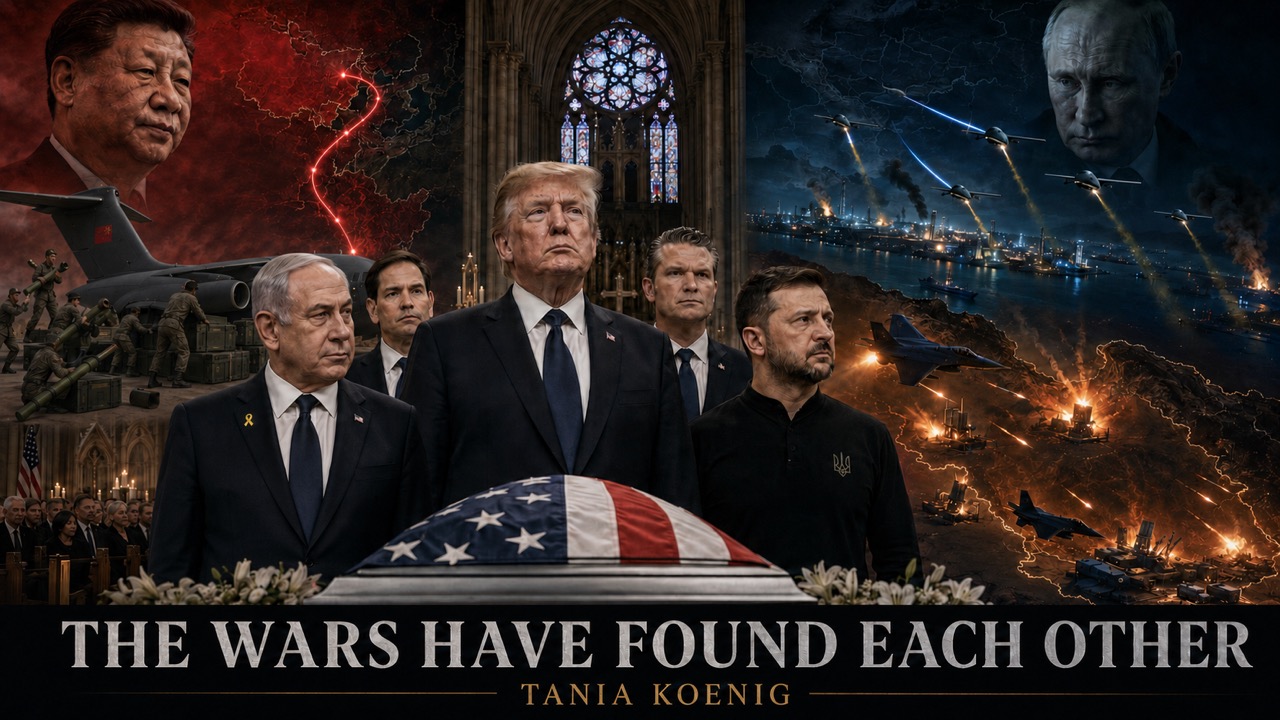
Between those developments stood President Trump’s meeting with Benjamin Netanyahu, Volodymyr Zelensky’s presence in Washington, Lindsey Graham’s funeral and a Senate vote joining pressure upon Russia and Iran.
The immediate reason for the bombing was Iran’s attempted missile attack against American forces in Jordan. Yet the larger meaning lay in everything that had gathered around it. These were no longer separate wars developing in distant regions.
The wars had found each other.
The strategy is turning upon its authors
The Chinese contract reportedly covers between 300 and 400 QW-12 and FN-16 portable air-defense systems, valued at approximately $60 million to $70 million. Beijing called the report groundless, while Pakistan denied involvement in the proposed route from western China through Pakistani territory.
These are not carrier-killers. They are mobile systems intended for low-flying aircraft, helicopters and drones. Their importance lies in Iran’s attempt to rebuild the defenses that American and Israeli operations have been destroying.
The possible route also explains Pakistan’s strategic value. Pakistan stands between western China and Iran. Whoever retains influence in Islamabad possesses leverage over one of the most practical corridors through which Chinese military assistance could move westward.
President Trump said he would be surprised if the shipment occurred and that Xi knew he would be disappointed. On the same day, he promised that Iran would be hit very hard. The diplomatic warning and the military action belonged to the same message.
China stands inside that contradiction. It has an interest in preventing Iran’s defeat and in limiting American power in the region, but it depends upon the energy system the war is destabilizing. An Iran capable of imposing costs upon Washington serves Beijing. An Iran that closes Hormuz, threatens Gulf production and raises the price of the energy sustaining Chinese industry becomes a strategic liability.
The reported contract occupies the space between those interests. It could help Iran survive without making China an open belligerent—provided the assistance remains deniable and the economic consequences remain manageable.
But the deeper pattern is reversal.
Russia invaded Ukraine to subdue it and instead produced a battle-tested power capable of reaching the routes between Russia and Iran. Iran supplied Russia with Shahed drones and forced Ukraine to master the weapon, defeat it and pursue the system behind it. Iran attacked American forces to impose a cost upon Washington and instead ended the pause that had protected it from further bombing.
The axis is creating the counterforce now gathering against it.
Washington has begun to see one map
By July 28, Washington was beginning to respond.
President Trump and Netanyahu spoke for approximately 90 minutes in the Oval Office, joined by J.D. Vance, Marco Rubio, Scott Bessent, Pete Hegseth and Steve Witkoff. Every principal course toward Iran was considered: diplomacy, continued economic pressure and a major military strike.
Netanyahu called it one of their best conversations. President Trump described it as very good. The significance lay not only in their words but in the room itself. American military power, diplomacy, sanctions and negotiations were represented around the same table.
President Trump had met Zelensky separately earlier that day. Netanyahu and Zelensky then spoke before Graham’s funeral, their first face-to-face encounter since September 2023.
Graham’s final political service may have been the gathering occasioned by his death. He had spent years arguing that Russia, Iran, Ukraine and Israel belonged to the same struggle. His funeral did not cause the bombing; it made the convergence visible.
That evening, the Senate voted 86 to 12 to advance the legislative vehicle for the Lindsey O. Graham Sanctioning Russia and Iran Act. It was a procedural vote, not final passage, but its scale was unmistakable.
By early Wednesday, the pause had broken on two connected fronts. Iran’s Revolutionary Guard said it had fired several ballistic missiles at Muwaffaq Salti Air Base and a U.S. military center in Jordan, describing the launch as a response to American actions against Iranian interests. CENTCOM said every missile was intercepted; Jordan said it had destroyed five. American and Saudi aircraft also struck logistics and weapons sites used by Iran-backed militias across eastern Iraq, saying the operation answered more than 30 IRGC-directed drone attacks during the previous 72 hours.
Less than a day after the Trump-Netanyahu meeting, United States strikes inside Iran resumed. The attempted attack in Jordan was the stated immediate trigger. “So it’s our turn,” President Trump said. The chronology does not establish that Netanyahu caused the decision. It does give their lengthy private discussion greater significance.
The pause had not produced direct negotiations. Mediators still carried messages; negotiations were not taking place.
Washington is no longer merely seeing one map. It is beginning to act upon it.
The power Putin created
Zelensky’s presence in Washington was more than symbolic. Ukraine has not defeated Russia, which still occupies substantial Ukrainian territory and retains important military advantages. Yet Ukraine is no longer only a regional victim waiting for larger powers to determine its future.
Years of fighting Iranian-designed drones gave Ukraine knowledge with value far beyond its own battlefield. It learned how the weapons operate, how they are improved and how the network sustaining them can be attacked.
On July 25, Ukraine struck vessels in the Caspian Sea that Kyiv said were carrying military cargo involving Iran. Tehran said an Iranian commercial vessel was also hit, killing one sailor. The precise relationship between those accounts remains disputed, but the strategic change is clear: the Caspian route between Russia and Iran is no longer beyond Ukraine’s reach.
Meanwhile, American analysts are investigating whether Russia assisted Iranian attacks through targeting information or advanced drone technology. No final conclusion has been announced. But if Moscow is helping Iran improve its attacks, Israel can no longer treat Russia as a power to be accommodated.
Russia helped Iran threaten Israel and America. In doing so, it may have transformed Ukraine into one of the few powers capable of physically damaging the Russia–Iran connection.
The encounter between Netanyahu and Zelensky did not create an alliance. It showed that their interests are beginning to catch up with the partnership between their enemies.
Alignment before alliance
Iran gave Russia drone technology. Russia is suspected of returning intelligence and technical assistance. China may provide Iran with air defenses. Ukraine can attack the routes joining Moscow and Tehran. America and Israel are again coordinating against the visible Iranian threat.
That is alignment before alliance.
Its prophetic significance does not require an invented timetable. Russia and China are moving closer to Persia through practical dependence, while Israel, America and Ukraine are being positioned in response.
Daniel describes a spiritual “prince of Persia” and a conflict that one messenger did not carry alone. Military power cannot defeat a spiritual principality; that belongs to the realm of prayer. But the visible system through which Iran threatens Israel, America and the region must also be confronted, and no single nation can confront the entire structure surrounding it alone.
Russia, Iran and China believed they were building the means to exhaust their enemies. Instead, they may have created the reason, the knowledge and the alignment required to confront them together.
No coalition has been formally declared, and every government involved still preserves its deniability. But the weapons, the intelligence, the routes and the targets already reveal the alignment.
The wars have found each other.