
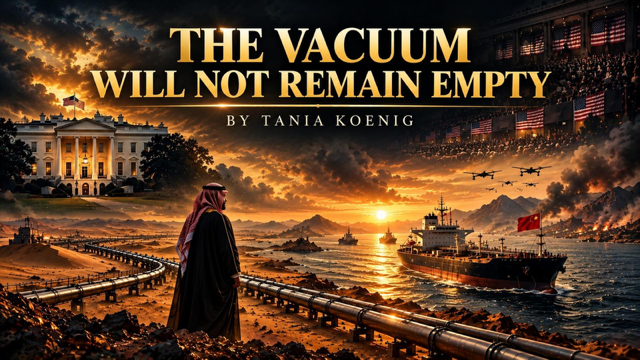
The Iran war can no longer be contained geographically, economically or politically. Saudi Arabia is confronting the limits of old guarantees, Americans are living with the costs at home, and China is positioned to gain from the space Washington chooses not to occupy.
By Tania Curado-Koenig | September 14, 2026
For six weeks I did not write. After The Wars Have Found Each Other was published on July 29, I believed I had said what the Lord was showing me and needed to watch what followed. I believe I was prophesying. I do not mean that I knew the date of the next attack or every decision a president would make. I mean that I believed the Lord was allowing me to see the direction before the individual events made that direction obvious.
The record is there. In March, I wrote that NATO members might act, but NATO would not enter the Iran war as one military alliance. In June, when Washington celebrated the memorandum of understanding with Tehran, I wrote that it could provide a pause but could not change the regime or remove the forces that had produced the war. In July, I wrote that China and Russia did not have to put soldiers beside Iranian soldiers for their technology, intelligence, commercial channels and strategic interests to affect the battlefield. Five days later I wrote, “The wars have found each other.”
What has happened since is why I am writing again. The war can no longer be contained geographically, economically or politically. What was decided months ago is now changing what governments decide today.
The War Followed the Oil West
For months the world’s attention has been fixed on the Strait of Hormuz. Saudi Arabia had spent decades preparing for precisely that vulnerability through the East-West Pipeline, carrying crude across the Arabian Peninsula to Yanbu and allowing Saudi exports to bypass the strait. The Iran war changed the value of that infrastructure dramatically. The U.S. Energy Information Administration estimates that crude oil and petroleum liquids moving through Hormuz fell from 21.6 million barrels a day in the final quarter of 2025 to 4.9 million in the second quarter of this year. Over the same period, volumes through Bab el-Mandeb rose from 5.4 million to 8.1 million barrels a day. As the eastern route became unreliable, dependence was already moving west.
Then the East-West Pipeline itself was attacked. Saudi Arabia says several drones launched from Iraqi territory struck the pipeline in the Riyadh and Madinah regions, causing injuries and forcing a precautionary shutdown. At virtually the same time, the Iran-aligned Houthis were advancing along Yemen’s Red Sea coast toward Bab el-Mandeb and intensifying attacks on Saudi territory. The pipeline that had grown more important as Hormuz faltered was attacked just as pressure built around the western passage.
There is no evidence that the Iraqi drone attack and the Houthi operations were directed from one command center, and there is no reason to claim that. Saudi Arabia nevertheless has to deal with both at the same time. As dependence shifts from one route to another, the infrastructure supporting the alternative becomes more important and more vulnerable. The war is no longer simply disrupting the old energy map; it is beginning to follow the routes governments use to escape it.
This is where Saudi Arabia takes the argument further than it was six weeks ago. The wars did not need to merge into one formally declared coalition. They were already affecting one another through routes, infrastructure, technology and political decisions. Saudi Arabia, positioned between the Gulf and the Red Sea, is now experiencing that convergence directly.
The Call Washington Declined
Crown Prince Mohammed bin Salman sought direct American military assistance against the Houthis. President Trump declined to authorize U.S. strikes for now, while Washington offered intelligence sharing and targeting assistance. American military cooperation with Saudi Arabia continues, and CENTCOM commander Admiral Brad Cooper subsequently met the crown prince in Jeddah.
America plainly has the military capability to strike the Houthis. Saudi Arabia is confronting a different question: when will Washington use that power directly on behalf of an ally? For decades Gulf security rested not only upon American weapons and bases but upon an expectation that, when the danger became serious enough, American power would ultimately be available. Riyadh must now calculate more carefully where that commitment begins and ends.
President Trump has understandable reasons for not wanting another front. The United States is already deeply involved in the Iran war, and another campaign would require additional military resources and political attention. America First cannot mean that the United States assumes every military burden in the Middle East. But Saudi Arabia still has the same security problem after Washington says no, and Riyadh must find another way to address it.
Only weeks before the present escalation, Saudi Arabia signed the Makkah Joint Defence Agreement with Turkey and Pakistan, declaring that an armed attack against one would be regarded as an attack against all three. By the end of August, the governments had agreed to establish a permanent secretariat in Saudi Arabia and mechanisms for political and military coordination. Yet when the first serious test came, Pakistan said on September 10 that no military response under the pact was presently being discussed. Islamabad has not repudiated the agreement, so it would be wrong to say the pact has failed, but its collective-defense language has not yet become collective military action.
Riyadh is therefore testing its oldest and newest security relationships almost simultaneously. Washington remains indispensable but has declined the direct intervention Saudi Arabia requested, while the agreement with Turkey and Pakistan has yet to show what its mutual-defense commitment means under military pressure. Saudi Arabia is not leaving America for another camp, but it has reasons to broaden its relationships because no single guarantee is answering every problem it faces.
China is already operating inside that space. When Houthi restrictions threatened Chinese tankers moving through Bab el-Mandeb, Beijing negotiated directly with the Houthis. Individual China-bound vessels were cleared, and at least four tankers passed under the arrangement. China did not reopen the waterway for everyone, defend Saudi shipping or assume responsibility for freedom of navigation. It obtained passage for its own ships through direct access to the force threatening the route.
American influence in the Gulf has carried the enormous cost of bases, carrier groups, intelligence networks, air defenses and a maritime order from which countries far beyond America’s formal allies benefited. China can remain Iran’s indispensable oil customer, maintain a major commercial relationship with Saudi Arabia and speak directly with the Houthis without promising to defend any of them. Beijing can gain influence without assuming the military burdens America has carried.
Xi Jinping’s conversation with President Trump in May looks different against this background. Xi invoked the “Thucydides Trap,” placing the U.S.-China relationship within the historical question of a rising power confronting an established one. Trump later wrote that Xi had referred to America as “perhaps being a declining nation,” although the public record does not establish that Xi literally used those words. Trump was describing what he understood Xi to mean and argued that whatever decline Xi perceived belonged to the Biden years.
Saudi Arabia’s request does not prove American decline. America remains extraordinarily powerful. But China does not have to surpass America militarily to become useful to an American ally where Washington cannot or will not act. Saudi Arabia can continue relying on the United States for weapons, intelligence and military capability, develop defense cooperation with Turkey and Pakistan, and use China’s access to Tehran or the Houthis when Beijing can open doors that are closed to others. If that continues, the change will not necessarily resemble one power replacing another. Countries that once organized most of their security around Washington may begin dividing their dependence among several powers.
Last week, while attending the Republican convention in Dallas, I saw another side of this. I heard Robert F. Kennedy Jr. give an extraordinary speech about the Democratic Party he once knew, free speech, faith, constitutional rights, Big Tech and corporate power, and why he now stands with President Trump. I also looked around the arena and saw empty seats. I am going to vote Republican, but those empty seats stayed with me because we heard the language of a golden age while many Americans are still struggling with the cost of ordinary life. My own energy bill has gone sky high. I pray America truly enters a golden age, but we cannot call something gold before people can see it in their own lives.
The economic consequences of the Iran war are not new, but they have acquired political weight. What began in shipping lanes and energy markets is now part of the environment in which an American president decides whether the country should assume another military commitment. Saudi Arabia’s urgent security problem arrives in Washington alongside expensive energy, inflation concerns, war fatigue and an approaching midterm election. The United States may possess the military means to do what an ally asks while the president decides that the domestic and strategic cost of another front is too high. The consequences of the war are beginning to shape where the conflict goes next.
Where the Nations Are Moving
Six weeks ago I wrote that the wars had found each other. Saudi Arabia is showing us what happens afterward. A war that could not be contained at Hormuz has followed the routes created to escape it. The kingdom has turned to Washington and discovered the present limit of direct American intervention, while its new defense agreement with Turkey and Pakistan is being tested almost as soon as it was signed. China, meanwhile, already has channels to Tehran and the Houthis that give Beijing a different kind of influence.
President Trump can decide, for understandable reasons, that America should not open another front, but the consequences of that decision do not stop in Washington. Saudi Arabia must still protect itself, Turkey and Pakistan must decide what their new defense agreement actually requires, and China can benefit without replacing America or assuming America’s responsibilities. The vacuum will not remain empty because the countries affected by it cannot afford to leave their security unanswered.
For those of us who stand with Israel, where these relationships eventually lead matters. An arrangement that satisfies Saudi Arabia, restores shipping or lowers oil prices does not necessarily remove the forces threatening Israel. I will not claim where Riyadh, Ankara, Islamabad or Beijing will ultimately stand when the facts do not yet establish it and the Lord has not shown me. But I believe we should watch the direction carefully, because relationships created by necessity can become dependencies, and dependencies can eventually change the position of nations.
The war that began with Iran has reached Saudi Arabia, the Red Sea, American households and the calculations being made in Washington. The wars found each other. Now we are beginning to see how they may move the nations, and why China does not need to replace America everywhere to gain from the places where American power remains present but American intervention does not.
Pray for Israel. Pray for America. Pray for wisdom in Saudi Arabia. And watch China—not only where it sends ships, but where it becomes necessary when Washington decides not to act.
---
Notes and Sources
1. Tania Koenig, “Why Markets Did Not Collapse Despite the Iran War,” Koenig’s Eye View, March 16, 2026.
2. Tania Koenig, “It Is Not a Deal. It Is an MOU. Trump’s Chaos, Iran’s Leverage, and the Alignment Around Israel,” Koenig’s Eye View, June 15, 2026.
3. Tania Curado-Koenig, “I Take Him at His Word: The Warning Disguised as Trust,” author-supplied manuscript, July 24, 2026.
4. Tania Koenig, “The Wars Have Found Each Other: How Iran, Russia, China, Israel and Ukraine Became Part of the Same Conflict,” Koenig’s Eye View, July 29, 2026.
5. Reuters, “Yemen’s Houthis reach strategic island at mouth of vital shipping lane,” September 11, 2026; Reuters, “Iran-backed Houthis reach Yemen’s Dhubab on Bab el-Mandeb Strait, sources say,” September 11, 2026.
6. Reuters, “Saudi Arabia lifts alert in southern city day after Houthi strikes,” September 9, 2026.
7. Reuters, “Saudis shut down oil pipeline as Houthis tighten grip on Red Sea shipping,” September 12, 2026.
8. Reuters, “Saudi pipeline outage threatens loss of 4% of global oil supply,” September 13, 2026.
9. U.S. Energy Information Administration, Short-Term Energy Outlook, August 2026: crude oil and petroleum liquids through Hormuz averaged 4.9 million b/d in Q2 2026, down from 21.6 million in Q4 2025; through Bab el-Mandeb, 8.1 million b/d, up from 5.4 million.
10. Reuters, “Houthi advance in Yemen puts U.S. in a new bind,” September 12, 2026.
11. Reuters, “Saudi crown prince, US CENTCOM chief discuss developments after Houthi escalation,” September 14, 2026.
12. Reuters, “Saudi Arabia, Turkey, Pakistan pledge mutual defence as Middle East turmoil escalates,” August 7, 2026.
13. Turkish President Recep Tayyip Erdoğan, public statement on the pact’s basis in Article 51 of the U.N. Charter, August 7, 2026, reported by AZERTAC.
14. Reuters, “Saudi Arabia, Turkey and Pakistan agree to establish secretariat under joint defence pact,” August 31, 2026.
15. Reuters, “Pakistan says no military response discussed under Mecca pact over Houthi attacks on Saudi Arabia,” September 10, 2026.
16. The Wall Street Journal, “How Much Oil Does China Buy from Iran?,” May 2026.
17. Reuters, “Chinese refiner Sinopec to boost oil imports from outside the Gulf,” August 24, 2026.
18. Reuters, “China in touch with Yemen’s Houthis to allow ships to sail through Red Sea, sources say,” July 28, 2026.